
Calayah Huang
Updated: Nov 29, 2025

Calayah Huang is a digital performance artist who has exhibited at the prestigious Tate Modern in London. Other exhibitions include CICA Museum in Gimpo, South Korea, PH21 in Barcelona, and RaidenNST in Shanghai. She previously worked as a curator at Not A Gallery, a space in London and is a graduate of the Royal College of Art, which is consistently ranked as the top art school in the world. Calayah’s work has been described as “a formative, exploratory phase, navigating the translation of performance art’s corporeal immediacy and aleatory qualities into highly systematised virtual environments through motion-capture technologies”.
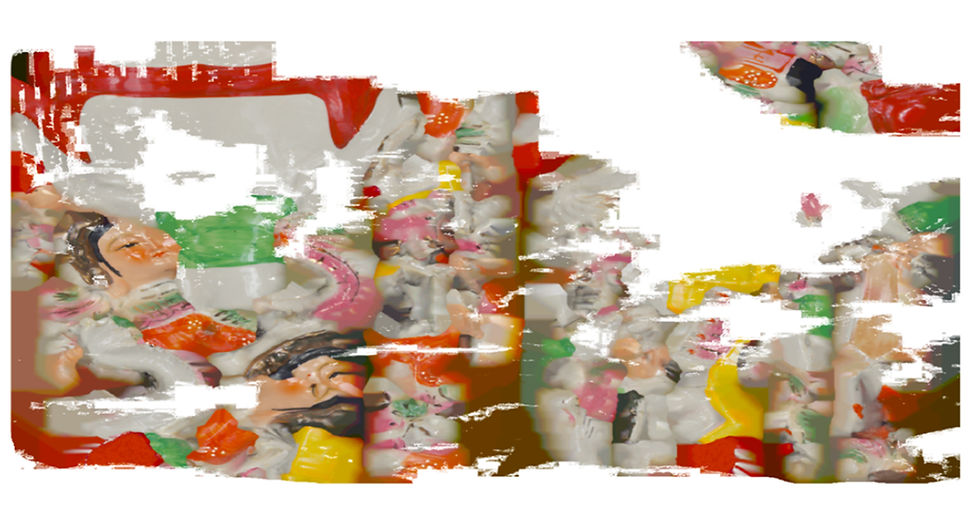
The main components in Calayah Huang’s digital performances are pixelization and distortion. Also, these works are highly integrative because they combine the artforms of collage, digital art, and performance into one illuminating aspect of conceptual expression. The baseline images of these performances are photographic collages of various objects such as porcelain dolls and other obscure elements. Through angular distortion and digital manipulation in front of a live audience, these images are pulled across a composition to be ‘pinched’, stretched, displayed in a way to communicate electrical interference. In a sense, the digital performances uses the element of distortion to express the nihilism of contemporary society. As if the angular pulls of the image along with the disturbing porcelain faces represent personal identity being erased and eradicated. Individuality and identity becoming blurred, pixelated, and disfigured for not conforming to commercial standards of living.

As a result, the digital performances can be described as anti-commercial and avant-garde in their very essence. What we have here is a barrier to communication and indoctrination, which also makes the works anti-institutional. The result of these distortions and blurs of imagery occurring live in front of an audience adds an element of suspense. A theatrical display of morbidity and child-like innocence becoming destroyed through the disturbance of mass-media culture and ‘acceptable’ social standards. In such a regard, the works are also deeply sociological. The colors of the digital collages should be noted for their mix of pasty bright and neutral tones, as if they were like pieces of candy wrapped in modest plastic.

Where has the Queen Mother’s Chair Gone (pictured above) remains the central tenant of what we have been discussing. This elaborate and concocted performance reveals a realm of angular distortion. A disfigured figure becomes lost through the dimension and interpretations of semiotics and plastic language.

What do these body of works represent? Calayah Huang advances performance art to have unusual integrative approaches with digital and collage applications. Her combination of two-dimensional art with three-dimensional reality of being a live event and guided by her analogue motions reveals further alien associations of visual stimulation. As a result, these works are highly experimental and reveal realms which destroy our notions of imagined comfort, an electrical disturbance which presents an empty space of an apparitional landscape. Such a scape may remind the viewer of the video game Morrowind, where a fierce storm in the introduction video becomes illuminated by intense electrical interference with a narrative enticing us to enter a realm of great mystery and investigate the unknown. These performative works by Calayah Huang represent unchartered territory in dimensions containing vast portions of emptiness being provoked and regurgitated amidst the background of contemporary digitized realms and platforms.


