
Cao Fei at Kunstmuseum Basel
Updated: Jun 10
Written by Joas Nebe.
The Kunstmuseum Basel presents the first major solo exhibition in Europe of moving-image artist Cao Fei (born 1978), whose formative years in China coincided with the cautious economic opening under Deng Xiaoping and whose artistic imagination bears traces of semi-legal Western imports alongside early imitations of Western consumer goods and their visual language. Growing up amid such hybrid material cultures, Fei began producing Hip Hop videos in the early 2000s, projects filmed both in Chinese cities (Guangzhou, Fukuoka) and abroad (Sydney, New York) with members of local Chinese diasporic communities, in which workers from diverse professions perform choreographies to hip hop beats: a police officer accompanied by a shackled prisoner, a shopkeeper posed before a storefront, and so on; the installation “Hip Hop” thereby pursues the transborder diffusion of Western pop culture.

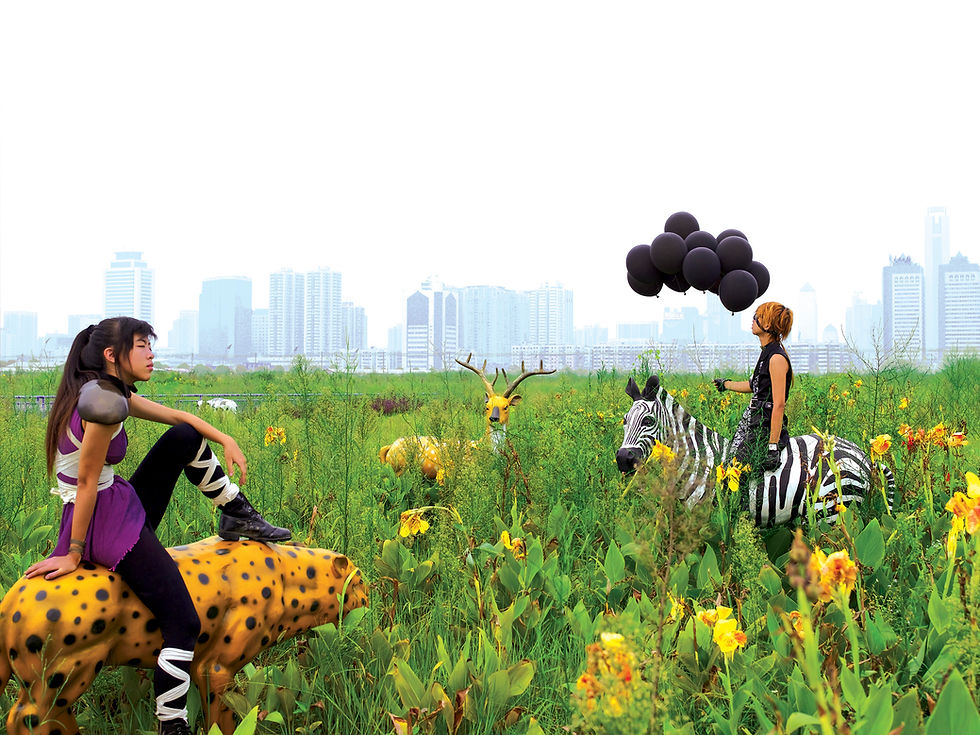
In Cosplayers (2004) Fei stages the playful appropriation of anonymous urban spaces, a motorway ring, a canal, by adolescent cosplayers, a youth counterculture around the turn of the millennium in China; the work’s documentary framing intensifies the contrast between sprawling, concreted residential blocks and the flamboyant fantasy costumes which seem to have leapt from manga and anime panels. Filling the entire museum building on the Rhine, the exhibition is organized by the artist into distinct zones conceived as ‘districts’: The Street (Hip Hop), The Park (Cosplayers), The Factories (Asia One), The Cinema (Nova, La Town), The Playground, The Office (RMB City), among others; visitors receive a printed map upon entry for orientation, while signage in corridors and at stairwells points toward each district much like wayfinding systems in airports or train stations.

In the neighborhood The Cinema, three feature films by Fei are shown. La Town (2014) is an interpretation of Alain Resnais’s Hiroshima Mon Amour. A female off‑voice tells a male off‑voice her story, about her feelings, about La Town, which is sometimes herself and sometimes a geographic place. The images are stop‑motion shots of toy train figures staging situations in an urban context: the arrival of a high politician, a chapel that receives him, an intimate bedroom scene, people in a garden, a strip club above a cinema. Then a demonstration, burning, destroyed cars, supermarkets, a burning industrial building. The film ends with a visit to the ‘Museum of the Night’, where individual scenes from the preceding events are presented in glass cases or on pedestals as display objects. The latent violence of urban coexistence is assimilated through musealization rather than confronted. The frame narrative and its reference to Hiroshima Mon Amour set the interpretive framework: Hiroshima is everywhere.

Within The Cinema, three feature films by Fei screen. La Town (2014) reads as an interpretation of Alain Resnais’s Hiroshima Mon Amour: an off-screen female voice recounts to an off-screen male voice a life, emotions and a place alternately identified with a person and with a geographic locale; images composed from stop-motion toy-train figures stage urban tableaux, the arrival of a high-ranking politician, a welcoming chapel, an intimate bedroom scene, people gathered in a garden, a strip club above a movie theater, followed by protest, burning wrecks, supermarkets, an industrial complex in flames; the film concludes with a visit to a “Museum of Night”, where fragments of preceding events are presented in glass cases and on pedestals as exhibited objects, so latent urban violence becomes assimilated through musealization rather than confronted, and the framing narrative’s reference to Hiroshima Mon Amour establishes a hermeneutic premise suggesting memory of catastrophe permeates everywhere.

The second film, the 100-minute Nova (2019), unfolds a temporally non-linear love story threaded between China’s communist past and the Soviet Union: in the 1950s and 1960s a team of Russian scientists is meant to assist Chinese counterparts in creating a world-market-capable computer, during which a romance blossoms between a Russian researcher and a Chinese engineer, while in a vaguely located future their son progressively uncovers traces of their history; although the piece melds genres, historical drama and science fiction, the development follows familiar genre topics.

Similarly anchored in recognizable narrative patterns, Asia One (2018), assigned to The Factories, depicts two young human supervisors and an AI robot overseeing an unmanned, fully automated logistics warehouse; human connection proves elusive until a malfunction sends conveyor belts awash with fruit, discipline briefly collapses, one attendant casts off a uniform and kicks pomelos through the hall, a moment in which playfulness, here framed as an essential human faculty, becomes reasserted. From a middle period, RMB City (2007–2011), shown in The Office, represents Fei’s experiment within Second Life, an early metaverse, where programmers constructed an artificial city whose economy operated and where participants could purchase land and trade; RMB, shorthand for renminbi, names a ‘city of money’, and the project, conceived from the outset as a two-year endeavor, terminated as planned in 2011, remaining accessible today only in archived form.

Cao Fei’s honours include the SCAD deFINE ART prize (2024) and the Deutsche Börse Photography Foundation Prize (2021); nominations include the Hugo Boss Prize and the Future Generation Art Prize (both 2010), while awards from the China Contemporary Art Award (CCAA) designate Fei as “best artist” in 2006 and again in 2016.

Photo credits (press images of Kunstmuseum Basel):
Cosplayers: A Mirage
Courtesy of the artist, Creative Vitamin Space, and Sprüth Magers
Hip hop Shanghai
Produced by nownessCourtesy of the artist, Vitamin Creative Space, and Sprüth Magers
Asia One
Produced by nownessCourtesy of the artist, Vitamin Creative Space, and Sprüth Magers
Asia One 01
Courtesy Sprüth Magers
RMB City: a Second Life City planning
RMB City: A Second Life City Planning 05
Courtesy Sprüth Magers
All other images: Cao Fei, Joas Nebe