
Luc Delahaye: The Detail in Conflict
Updated: Jan 9
Written by Joas Nebe.
Luc Delahaye (born 1962) worked as a war photographer in the 1990s. War photographers are at the heart of the action. They require highly automated and lightweight equipment that can be quickly moved from one location to another. The images captured with these small (digital) cameras have a certain resolution, dictated by the medium, film or later, the chip in the camera, which is sufficient to be published in newspapers or magazines.

Often, the lack of clarity, detail, and sharpness in our consumer perception is seen as a sign of authenticity. Grainy videos and shaky photos in unclear lighting conditions have come to be associated with the horror of war over time. Moreover, horror genres in fictional film have utilized this visual aesthetic since the early 1960s to intensify the sense of horror. What cannot be seen in detail must be filled in by the viewer's imagination, and what the imagination adds always creates a diffuse noise of uncertainty. This is how zombie films, slasher movies, and so on function.

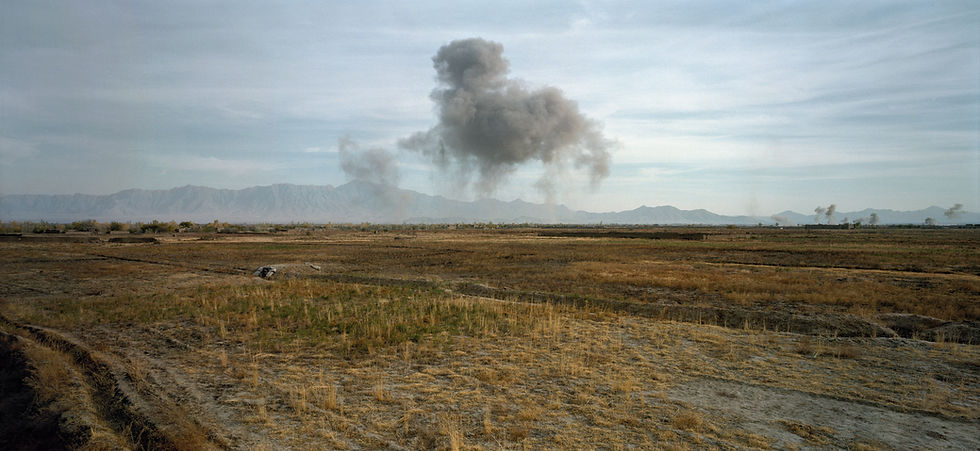
Delahaye is aware of this connection and sets detail against noise, the unclear, and the supposedly authentic. For about 25 years, Delahaye has worked with panorama cameras, which produce images akin to those used by Hollywood cinema in the 1950s with its widescreen films. Panoramic images are the opposite of what has been established since the development of portable roll film cameras: a more horizontally wide than tall photograph that resembles the landscape painting genre. The panoramic image envelops the viewer because it fills their field of vision. The 4:3 roll film format represents a single glance. The panoramic image requires extensive viewing. A 4:3 format photo must convey its message at first glance. The panoramic image is one of overwhelming, akin to a theater stage where there’s no tailored action for the protagonist, unlike in narrative films.

By choosing the panoramic image for his work, Delahaye refuses the supposed authenticity of classic war photography, which relies on incompleteness. Delahaye does not evoke horror at first glance. The suspense creeps into his photos through the clearly recognizable details which dominate the entire picture space. The lowered blind is as distinctly depicted as the features of the tilting soldier (Soldat de l’armée syrienne, Alex, November 2013-2024). In “The Milosevic Trial,” the soundproofing structure is depicted just as clearly as Milosevic's face. In this image, the furniture in the courtroom gains more significance than the monstrous crimes of the accused Milosevic. The structure of what the system symbolizes dominates the foreground and thus the meaning of the image.

The enormous photographs, which can quickly take up a wall and compete with the large paintings of the French Empire in this regard, often emerge from countless shots that Delahaye combines into a detailed large image using a computer.

However, the fidelity to detail comes at a cost and undermines what it initially appears to be: authentic human interest photography. The protagonists pose in a staged situation that somewhat resembles an event that took place at some point, as the work process requires endless photo sessions and gigabytes of material needed for the computer to output such a detailed large format. The refugees in “Un Feu” pose by the fire somewhere around Calais, just as the boy does on the olive tree somewhere in the West Bank (“Revolte”).

By moving towards a staging designed to overwhelm the viewer, Delahaye refuses the simple statement war photography with clear messages, which must be immediately recognizable, demands. By reenacting conflict, Delahaye creates a reference, a kind of over-sign of what lies behind the staging: the reality of human violence.
Galerie Nathalie Obadia
3, rue du Cloître Saint-Merri
75004 Paris
-
91, rue du Faubourg Saint Honoré
75008 Paris
+33 1 53 01 99 78
+33 6 29 41 77 10
Photo credit: Luc Delahaye, courtesy of Galerie Nathalie Obadia
Récolte
Un Feu
Jenin Refugee Camp
US Bombing on Taliban Positions
The Milosevic Trial
Soldats de l´ß armée syrienne, Alep, novembre 2013-2023