Marina Detsch
Marina Detsch is a self-portrait analogue photographer who has exhibited in Greece, Germany, and Brazil. Recent exhibitions include Holy Art Gallery in Athens, Unioeste Brazil in Toledo, and Grabowsee in Berlin. Her exhibition and participation at Grabowsee Art Residency entailed an abandoned hospital which was built in 1896. Marina describes her process as the following: “I shoot all my self-portraits on 35mm film, primarily working with an SLR and my trusted 50mm or 35-80mm. Because I work with analogue and can’t see the results right away, I had to learn to trust myself and figure things out as I go. Over the years, I have created some techniques such as the use of reflections to help with my body language and composition. When the reflections are not possible, I try to listen to my body and focus on what my form is trying to express rather than forcing an unnatural pose”.

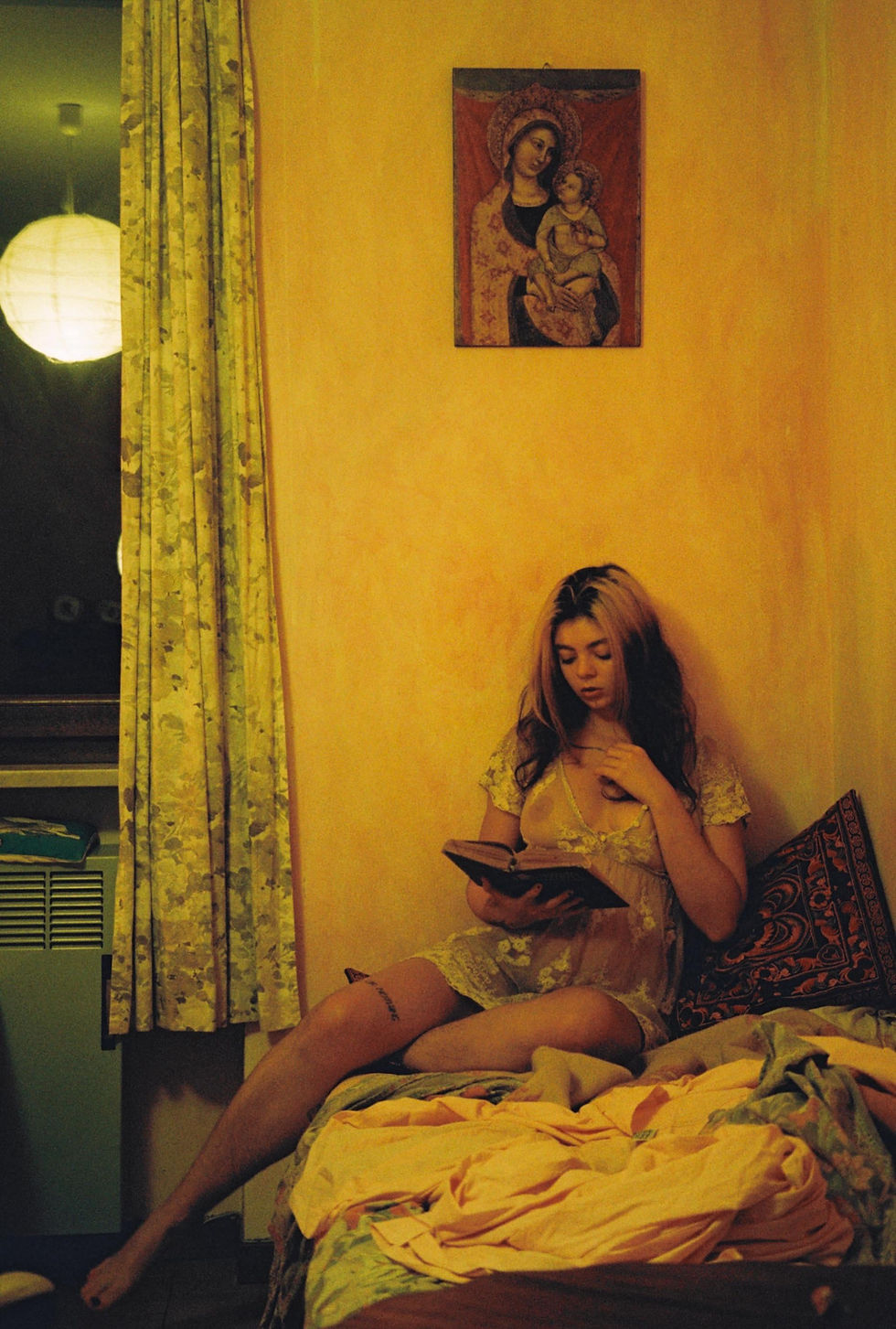
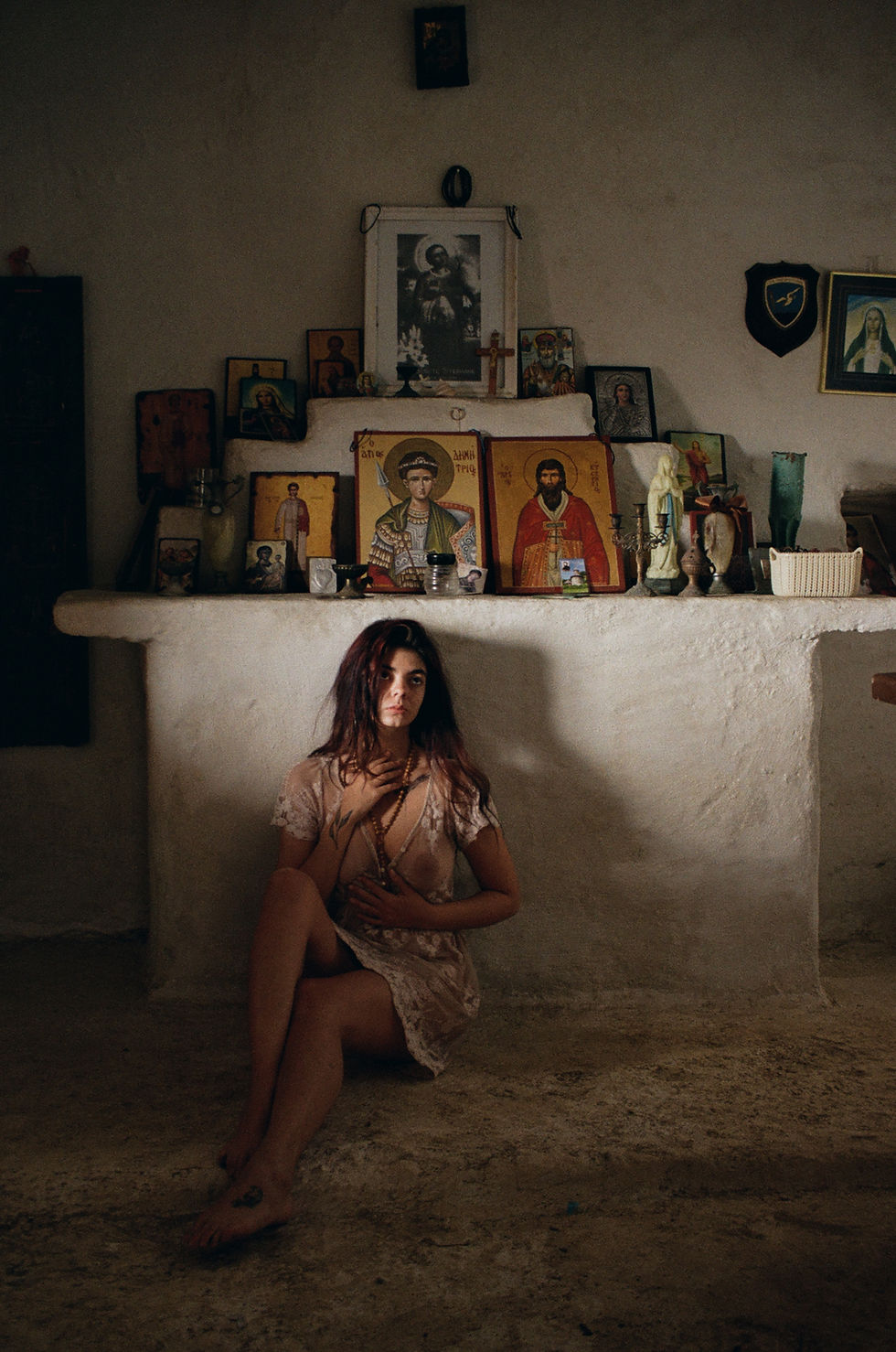
These performative photographs entail Marina Detsch using herself as an actor usually nude or in lingerie amidst various natural and aged environments, such as a pier on a lake, dilapidated infrastructure, or even her own venerable apartment. The analogue photographs reveal Marina in a natural state of mindfulness amongst her backgrounds and revealing expressions, such as pointing the double middle finger from her backside. She seamlessly integrates with these unfamiliar scenes, such as standing completely nude amidst a 19th century doorway or conveying irony by posing in revealing lingerie amidst what appears to be an ancient monastery or church built inside caverns. She locates isolated locations, far removed from contemporary civilization which are often rustic and battered, conveying photographs which come off as natural, especially in the backdrop of expressing her sensual nude form.

With a vintage, grainy quality yet unmatched detail, these analogue format photographs enhance the ancient overtones of Marina’s environments. In a state of naturality, these poses she renders within the analogue photographs offer not only sensuality but also casual provocation. She often poses nude or in revealing lingerie with Orthodox Christian imagery, such as gilded and framed Byzantine art as well as traditional crucifixes. These actions appear to reveal she either personalizes her relationship with traditional forms of Christianity or offers to liberate the church through expressions of naturality in nude form. As a result, these works raise questions as to how Christian society reacts to nudity in artistic form when outside the realm of the Renaissance. Marina Detsch seems to build a relationship with her environments, whether spiritual, secular, or natural through integration of her shadow, double and triple-exposure impressions as well as straightforward unrehearsed or unmodeled expressions and poses. Like slipping into a warm bath, she seamlessly blends in with these structures and landscapes through the grainy consistency of analogue processes.

Rippled Siren (pictured above) reveals Marina on a pier in front of a lake. Her post-actions are shown as a late subtle ripple on the water becomes exposed as she lays nude on the wooden plank. As an actor, she almost seems as if testing the temperature of the water before taking a skinny dip into the lake. Her dark amber dried hair correlates with the earthy tones of the inky water and aged pier. Finally, the sun just partially illuminates the top portion of the photograph as if being close to the time of dusk or the ending of dawn.

Analogue photography can create rich dimensions, void of any digital alterations and presenting a pristine finish with rich contrast and grainy texture free of pixels. The unedited works of Marina Detsch in such a regard are refreshing in providing the audience improvised performances in front of an unfiltered screen. She conveys her environments with a sense of comfort and nurturing, as if she is becoming one with her surroundings. The authentic photographs are captured in a process of improvisation and reveal a lack of tension as Marina seamlessly blends with these aged and natural environments, tucked away from the revealing eyes of contemporary society. As a result, these photographs convey an escape, a sanctuary of remote and private locations which serve as a reflection of the natural self and embarking in a state of comfort as well as solace from experiences of the outside world.