
Performance: Echoes of Perception by Fina Ferrara
Updated: Apr 7

Echoes of Perception by Fina Ferrara is interactive performance art but presented in a manner similar to theatre, with a formal stage and seated audience. The conceptual basis of the performance conveys the Kuleshov effect, a film editing practice leaving the audience with different interpretations of the same action when presented with various visual contexts. Fina’s performance entails short 5 minute screenings of clips from several Hollywood movies. These films include The Circus by Charlie Chaplin, Disney’s Dumbo, David Lynch’s Mullholland Drive, The Notebook, Possession, and Singing in the Rain. Each clip is meant to symbolize a different emotion, for example, The Circus represents fun and laughter, Dumbo represents sadness, Mulholland Drive conveys mystery and suspense, the Notebook is about romance, Possession symbolizes fear and repulsion, and Singing in the Rain represents joy.
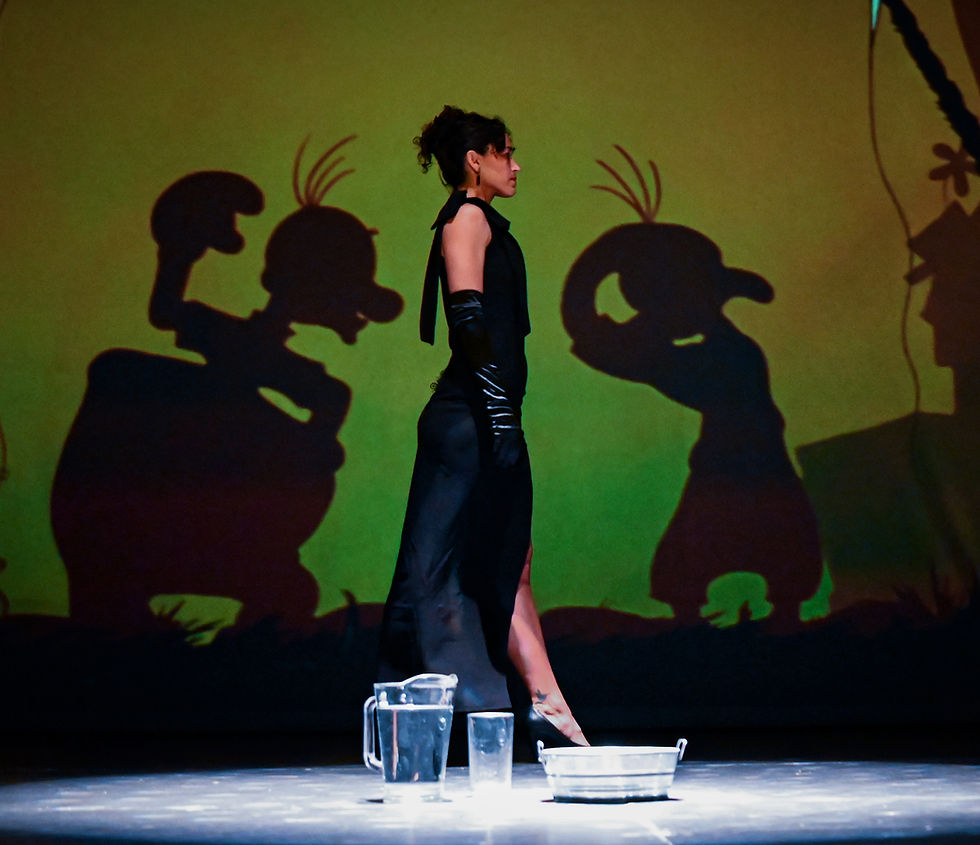
With the screening of these film clips, the audience is reintroduced to Fina Ferrara each time for a repeated performative action. Each sequence entails the following: Fina enters and walks across the stage, turns back and proceeds to the center of the platform, removes her gloves, leans down pouring herself a glass of water, stands up, takes a drink, leans down again, grabs a metal basin, opens her mouth and allows the water to pour from her lips onto the basin, stands up, places gloves back on, and proceeds to calmly exit the stage. This mindful repetition symbolizes a different conceptual notion to the audience during each sequence, based on the film clip projected, despite containing the exact same performative action. What this means is reality becomes defined by context and perception rather than actual occurrence. As a result, the performance is highly sociological and maybe even political, indirectly alluding to themes such as influence of the media and social platforms to the general public as well as how propaganda affects the masses.

There are 77 photographs documenting the performance in detail. Even in photography, the performative movements appear contrasting and peculiarly unique during each sequence despite sustained, repetitive action. Particularly, the photographs displaying the performance during the screening of the clip from David Lynch’s Mulholland Drive comes off as strikingly more dramatic and suspenseful than the rest of the photographs portraying Fina’s actions. Echoes of Perception, beyond social commentary on media and propaganda, seems to also convey a conceptual notion on the purpose of art. Does performance and the visual arts lead to alteration of cognition and a distortion of factual reality? Fina Ferrara’s performance is based on facts. The repeated actions are the same, yet the audience is convinced there is more complexity, individuality, and nuance throughout each act. Perhaps the lessons we can learn from Echoes of Perception would be the masses of the people are easily to manipulate, provided they are fed information through a distortion of contexts.

The socio-political themes within Echoes of Perception are apparent conceptually, even if they are indirect. What we can take away from the performance would be the power of illusion. Not in a context of Aristotle's philosophy comparing furniture to painting, but rather a communicative element far more complex. Illusory qualities can be altered not just by creating a two-dimensional imitation of a sequence, but also, and more convincingly, by altering the circumstances and presentation of visual information presented to the viewer. Such a conceptual complexity reveals Fina Ferrara’s performance as a deeply philosophical, mind-altering experience which shatters out notions of pre-conceived notions.

Is reality solely based on what we see or how a sequence becomes imitated? No. Fina uses the Kuleshov effect to great forcefulness towards understanding how easily the human mind can be convinced to believe a distortion of actuality and occurrence. For example, during the screening of the clip from the film Possession, the disturbing, violent scenes of convulsions drove the audience to feel they wanted the performance to end soon until the finale containing Singing in the Rain. Before the performance, Fina doubted the Kuleshov effect would work in performance art, but her experiment proved to be successful as the audience perceived each act in a unique manner and a good portion of the audience was completely unaware and mystified to learn the exact same performative action took place during each sequence.

A question becomes pondered. How does Echoes of Perception affect a state of repetition or the concept of the mundane. The performance is quite simple, yet with a specific context and visual manipulation, becomes a universe of complexity unraveling narratives and social commentary on how we interpret reality. In a sense, when art is involved, the performance seems to communicate the notion of actual occurrence and facts to be nothing more than illusions, manipulated information for the artist to play with. Of course, facts are grounded in reality, however, in visual art, especially in performance, the artist or actor is much like a wizard conjuring up mystical illusory and ethereal experiences or even enchanting their environments.

In terms of the generic attributes of the performance outside the Kuleshov effect, the removing and fitting of the black gloves seems to convey a concept of anticipation. If Fina were to drink the water and pour from her lips into the basin with the gloves on, we would interpret such an act as impulsive and improvisational. The action with the gloves communicates a sense of preparedness and careful planning. Releasing the water from her mouth and crouching down reflects morbidity and disturbance, with particular effect during the screening of David Lynch’ Mulhollad Drive. Through absurdity and ambiguity, the mysterious actions enhances and accentuates the Kuleshov effect to have meaningful impact of varying interpretations from the audience from each sequence. Entering and exiting the stage, along with walking back and forth, during each 5 minute screening, Fina Ferrara is ‘resetting’ the platform and basis of the performance, and again, spotlights the relevance of the Kuleshov effect.
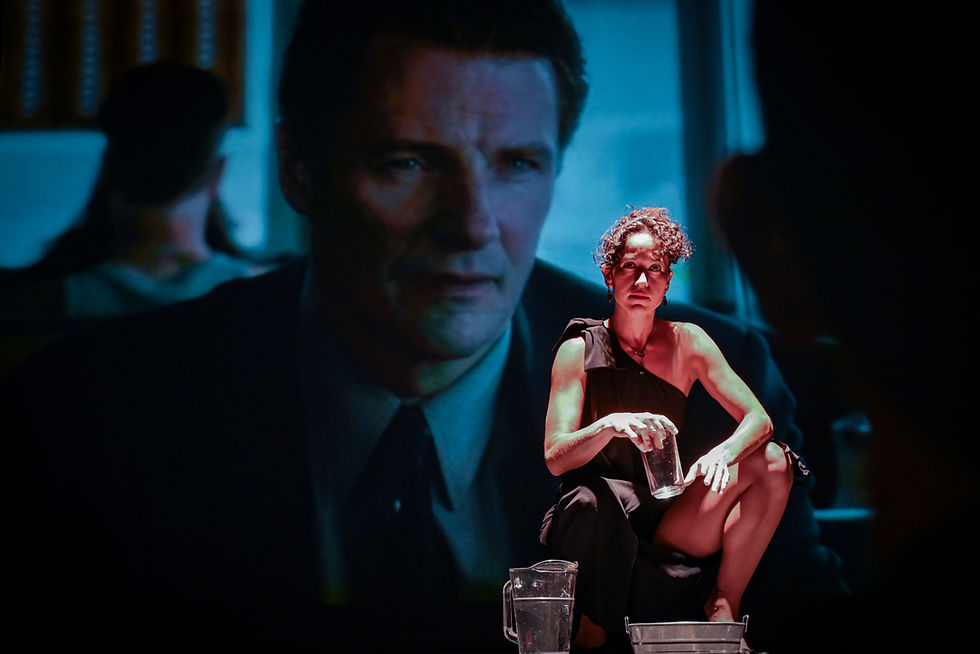
Suspenseful, confusing, mysterious, illusory, enticing, Fina Ferrara’s Echoes of Perception leaves impressions and then shatters illusions of perception like a hammer to fine glass. The impactful performance is quite palatable in photography because each moment becomes an isolated occurrence, a frozen moment of time. Fina portrays herself confidently and evocatively postures effectively similar to a fine marble statue, contrasted against ominous, dramatic stage lighting and monumental screens which seem to immortalize and idealize moments of lucid cinema which have come to define the emotional symbolism of our culture. Fina Ferrara’s Echoes of Perception identifies performance as an artform with deep conceptual impact which has miles of depth beyond an initial surface or impression, a conduit of visual communication to expand our collective and individual consciousness to unfamiliar horizons.


