
Shea Wilkinson
Updated: Nov 29, 2025

Shea Wilkinson is a fiber artist and costume / fashion designer who has exhibited extensively across the United States and internationally in Russia and China. Recent solo exhibitions include Blue Mountain Community College in Pendleton, Oregon, Gallery 72, Fred Simon Gallery, and Hoover Studios in Omaha, Nebraska, and Gallery 92 West in Fremont, Nebraska. Her collective exhibitions include Tsinghua University in Beijing, Russian Academy of Sciences in Moscow, Gallery 1516 in Omaha, Nebraska, Mesa Contemporary Arts Museum in Arizona, Schweinfurth Art Center in Auburn, and Marin Museum of Contemporary Art in Novato, California. Shea’s awards include First Place prize at Gallery Universum in Barnaul, Russia, Juror’s Choice Award at 39th Annual Contemporary Crafts in Mesa, Arizona, The Catherine Hastedt Award for Hand Workmanship, and Chrysalis Award presented by the James Renwick Alliance in Washington, D.C.
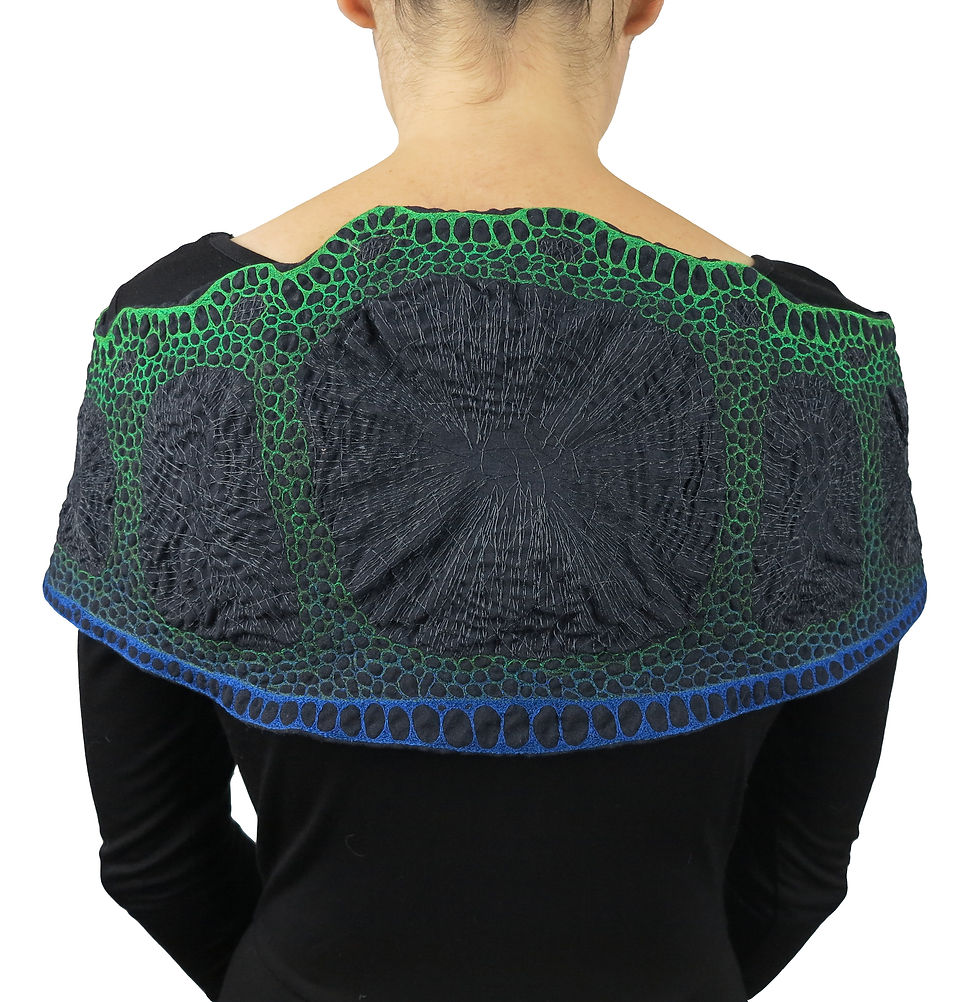
With about a dozen sets of series in her portfolio around the medium of fiber, we will be focusing on four particular bodies of works which are the Frutex, Mini-Series, X-Ray Contour Maps and New Discoveries: Maps series. Shea Wilkinson often incorporates the finest materials in her fiber works such as silk, wool, and cotton and has meticulous processes such as kneading and hand-stitching. She also sometimes includes glass beads into the pieces. The reason these four sets of series particularly stand out is because of their tendencies to accentuate the texture of the raw material, have three-dimensional elements to them, and contain forms which integrate with interdisciplinary practices such as fashion and costume design. These fiber works are inspired by topographical maps and patterns in plants. With a geological and geographic approach, a few pieces emulate the formations of an archipelago with various continent islands or even a pangea with archipelago-like features. The patterns on these topographical pieces has the fiber assembled in a pattern which seem like satellite or thermal observations. Such an interpretation with delicate intricacy in personalized markings reveals an artist deeply inspired in the relationship between visual art and science, particularly the study of the earth.

What makes Shea Wilkinson’s fiber art so extraordinary is their range in variation. No two pieces are alike and employ wildly flamboyant and even fantastical patterns at times while conveying observational and data-based interpretations in other works. She typically subdues her bright linear patterns with rich dark colors, such as blacks and shaded blues, or saturates them with pale neutral hues. The fashionable and costume-wears feature a figurative element to Shea’s art outside of illusions. These models wear the fine tapestry of patterns which are a reflection of natural foliage but also clearly based in human-interpreted structures. With fine markings blending in with the actor’s dresses, these pieces offer distinctions which seem to emanate a sense of regality and prestige. With intricate cell-like forms and topographically-inspired designs, these fashionable wears create a distinct pulsing effect, as if these garments were living organisms.
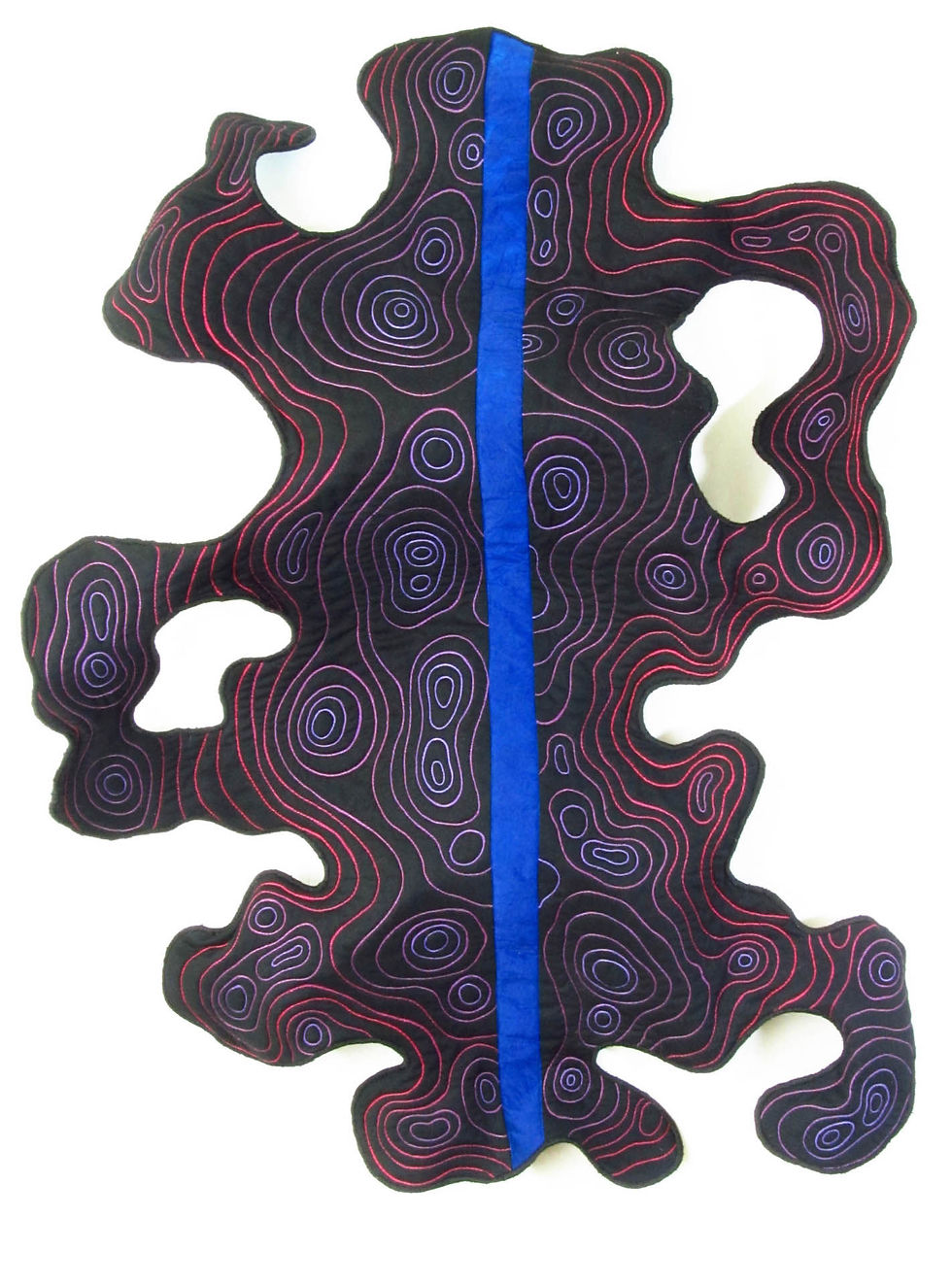
Antlia Dwarf (pictured above) remains unusual in Shea’s portfolio because of the dominant blue stripe would vertically lays upon the piece. Emanating from the X-Ray Contour Maps series, Antlia Dwarf resembles a pangea continent and the blue strip could represents the borders of a nation. The piece remains not only divided but complex in variation, these areas separated by the ‘border’ are extremely asymmetrical and represent a standard much like the flags of all countries.

Containing studies of physical earth and plants as well as incorporating imaginative patterns and markings, the works of Shea Wilkinson expand our understanding of the potentials of fiber as a medium. From the integrative applications of turning fiber artworks into elaborately regal mantles, scarfs, and accents on costumes to revealing the wonders of science and geological and geographic conceptual musings. As if the artist is contemplating the earth being reformed into new continents or the planet’s natural entities such as plants evolving into new forms. In a way, these works mark an evolution in manipulating form observed through technology (such as computerized topographical renderings) and turning them into realms of substantive physicality assembled by hand. These are analogue interpretations inspired by the realms of technology and intricately fabricated and sewn into elaborate costumes, installations, and experimental forms as well as layouts.


