
Vigilant Installations: featuring Won Ji Lim
Updated: Oct 7
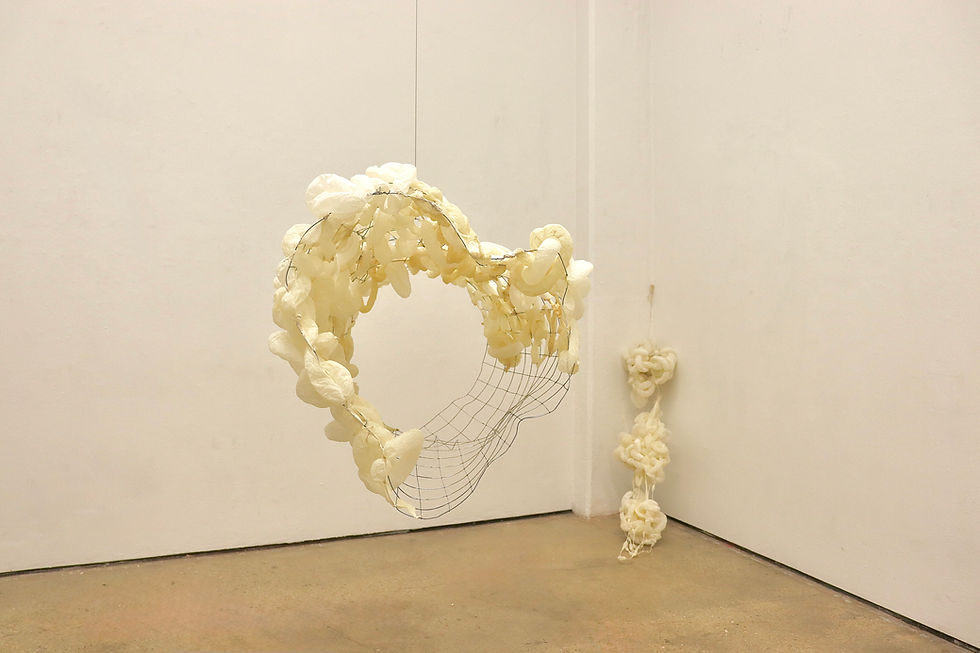
Although the works of Won Ji Lim are technically interdisciplinary installations in physical form, they are more similar conceptually to performance in their temporary, unstable, mechanical, and provocatively interactive nature. What essentially these artworks exemplify is using the art of installation in not only unfamiliar practices, but also in methods which highlight states of psychological distress. In a world full of war, income inequality, cronyism, corruption, and social collapse, invoking psychological aspects in contemporary art allows us to understand how the self as well as the collective reacts to how society treats us as a whole and individually. We may typically describe certain neurological disorders as a sickness, but these diagnoses also reveal a certain way of thinking enhancing an avenue of thought uncommon in formal thinking. For example, many of the greatest minds of history were known to be bi-polar, neurodivergent, or had some other similar disorder, such as Nikola Tesla, Nina Simone, Vivien Leigh, and Anthony Hopkins.

In the installation works of Won Ji Lim, she specifically deals with the theme of hypervigilance which she has suffered from. Hypervigilance is a form of mania which also induces behavior described as obsessive-compulsive. Essentially, when someone is suffering a bout of mania from hypervigilance, their mind is in a constant state of alertness. Examples of Won Ji Lim’s past behaviors with hypervigilance include being induced to write an essay over and over again over one mistake or insisting on rearranging everything in a room to be perfectly aligned for no apparent reason. The installations she constructs are macabre machinations on these psychological impulses, configurations which are fragile, temporary, and even made from easily decayable biological materials such as hog casings. From elaborate pulley systems to stringed grids and wire meshes holding delicate organic matter, these installations are a commentary on how we individually and collectively deal with altered states of minds, whether impacted specifically by hypervigilance or outside elements.

We often focus on the sociological aspects of contemporary art, but what about the psychological? Although ‘disorders’ psychologically can have severe negative consequences which can lead to all sorts of adverse reactions, they can also shed light on how we deal with particular subject matter in art. For example, imagine a photographer in a state of mania who obsessively photographs the same mountain for six hours, then goes home to figure out how to configure these images into an installation, spending an entire night planning and scheming his photographic installation design. The idea is not to romanticize the notion of psychological ‘disorders’, but to realize they can sometimes lead to creative outcomes in the arts shedding light on new or unusual practices in conceptual ruminations.

In regard to installation, this is one of the youngest art forms available to artists today. Historically, conventional sculpture has been a thoroughly exhausted form of art, similar to painting. With installation, the possibilities are endless. Installations come in many forms, they can be three-dimensional in essence, fragmented, photographic, mechanical, incorporate moving-image and performative elements, environmental, or even suspend from the air. Installations are usually temporary in nature, but they can set up to be permanently placed in some instances, such as outdoors interacting with landscapes and nature. Try to think of the art of installation as a much more advanced form of sculpture due to the potential of such constructions. Comparing the art of installation to conventional sculpture is like contrasting quantum computing to silicon-based computer systems. As a result, the art of installation is a vigilant form of art which communicates advanced practices of conceptual interpretations pertaining to psychological aspects, reactions, and yes, even ‘disorders’.


