Why Low-Brow Collectors / 'Experts' Don't Matter
- Editor at Titan Contemporary Publishing
- Nov 19, 2025
- 5 min read

Updated: Dec 27, 2025

This article is a sequel to the essay Painting is Deader than Dead. According to Saatchi Art, the world’s leading online gallery, finding the “perfect work” depends on the size of your wall space, orientation, placement, and if you decide to have salon walls. But Saatchi Art is not the villain, they are merely following the market. The art market has no distinct head, in today’s art market we are all followers without a leader and we generally follow the tastes of the low-brow collector and low-brow ‘experts’. In fact, the current art market is not very efficient. According to data posted by Contemporary Art Issue, 30% of all galleries are losing money and only 18% of galleries are running at a profit margin at or above 20%. Also, 56% of all galleries in the world are located in just three countries: the United States, the United Kingdom, and Germany, with most of those 56% of galleries concentrated in New York, Los Angeles, London, and Berlin. Finally, 99% of collectors are one-time buyers. What does this data reveal to us? This information tells us people are bored and burned out on art.
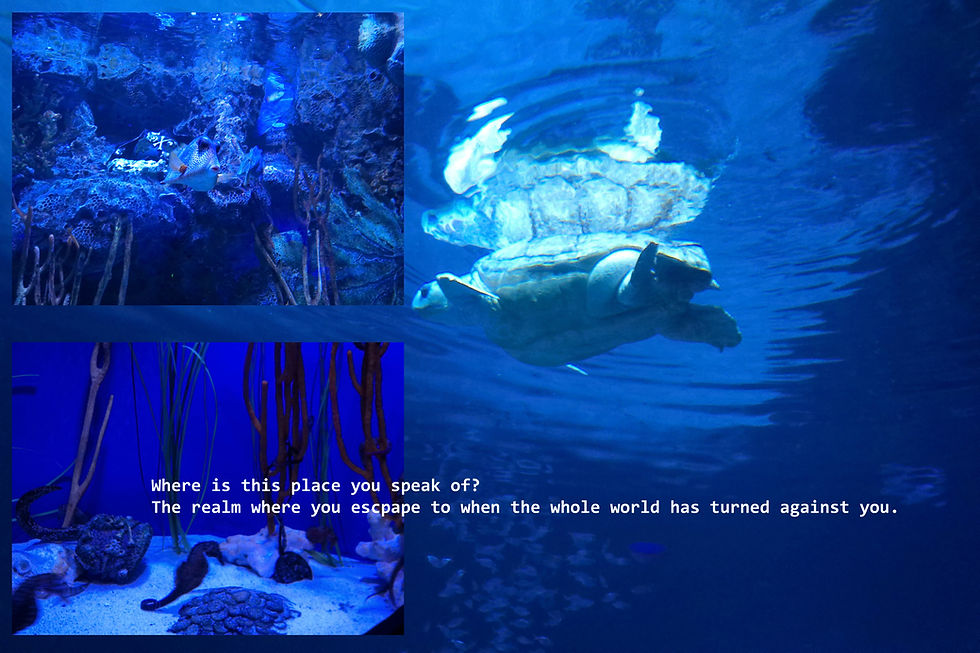
photographic assemblages (with unedited photography) by Michael Hanna
Another interesting fact, if you visit the art center of the world in Chelsea which has about 400 galleries within a 9-block radius, you will notice much less painting on display at the higher-tier galleries in this district. In many of these elite galleries, painting is completely nonexistent. What about academia? If we look at higher-tiered academic institutions like University of the Arts London, you will notice they usually feature more experimental art like performance-based work as well as fashion / costume design. And what about contemporary museums? If you visit contemporary exhibitions of the upper-echelons of the museum world like the MOMA or the Whitney you will find painting, drawing, traditional sculpture and traditional ceramics to be almost totally absent as well. So while the masses of the art market are driving themselves into a bored frenzy over painting and other traditional forms of art, the enlightened elite of the art world are focusing on more experimental artforms such as installation, performance-based work, photography, fiber, costume design, assemblage, etc.

There is a prevailing trend amongst ‘low-brow experts’ as I like to call them, who encourage artists to ‘make their art more accessible’, which is a nice way of saying ‘make your art more stupid’. These particular individuals hide behind the shield of virtue signaling and portray themselves as pure saints. However, what they really intend is to increase the commercialization of the already over-commercialized art world.

As we mentioned earlier, 99% of collectors are one-time buyers. Which means a vast majority of collectors have no skin in the game, their limited one-time purchase has minimal impact on driving contemporary discourse. As a collective they are powerful, but individually, most of them are irrelevant in terms of shaping how the visual arts has an effect on society as a whole. Those willing to finance the arts on a more consistent basis have a greater say in how the art world functions. Some may interpret this essay as a form of elitism, however, what these individuals don’t understand is, the real counter-productive form of ‘elitism’ comes in the form of forced-acceptance regarding mass-consumption. The prevailing attitude in the bulk of the art market of visual art consisting of painting, drawing, traditional sculpture, and traditional ceramics is the real elitism. A form of entitlement not based on merit, but rather on cheap tastes and vapid thrills. A form of entertainment rather than a deeper experience or purpose.

So what should artists do? Paraphrasing the philosophy of the Belgian billionaire art collector, Alain Servais, the first step in becoming a relevant artist is to put down the brush (and I would add put aside your clay). As far as we are concerned at Point Pleasant Publishing, mediums such as painting, drawing, traditional sculpture, and traditional ceramics have no meaningful future or impact on contemporary discourse. We are not afraid of people who push these forms of art because they don’t matter in the grand scheme of the advancement of the visual arts and they have limited influence and capabilities. Influence…is what really matters in the visual arts. If the artist does not have a desire to have an impact evolving contemporary discourse or the advancement of society, then what is the goal of the artist? To make money? My advice would be to go get a real job then if you want to make money while the rest of us try to be avant-garde. So for those looking for guidance, what are the artforms which have a distinct future in the arts? The answer is photography, performance and performance-based art, video, film, installation, assemblage, collage, fiber, printmaking, light design, jewelry, fashion / costume design, and analogue digital (no AI). We say no artificial intelligence because AI is no more than total automation, and there is nothing revolutionary in completely automating your work.

If we collectively realize these figures in the art world who promote traditional forms of art have minimal impact on contemporary discourse, then we can move forward. Their money matters more than their mouth, in other words. They project strength greater than their actual capabilities. In a way, they are living illusions…much like a painting. The mirage, or illusory qualities of influence in the arts from certain individuals comes from those who seek to either make a quick dollar or make the visual arts more vapid and diluted in substantive qualities. Substance…is the word for the future. Artists should make art which has real substance. Interpret the times, the artist should react to society and their role within civilization. Artists should be experimental and not afraid to change course.

What impact does a contemporary painting have on the grand scheme of society? Minimal to zero. Seriously, think about this…What do these low-brow collectors / ‘experts’ hope to achieve? A low-brow revolution? My statement to artists who work in traditional forms of art is if you want to water-down your work to appeal to the masses, then knock yourself out. Just don't expect the rest of us to imitate your behavior.
What makes a great work of art? A notable artwork, artistic feature, or performance should elevate you and bring you to a higher level. The goal of visual art should not be watered down in order appeal to your sensibilities based on familiarity, but rather to have you reconsider the world around you to have a deeper purpose and meaning.
Art is not meant to appeal to the masses, rather the masses need to educate, enlighten, and uplift themselves to the level of the artwork. Visual Art represents an element greater than ourselves, even as a collective. Without art, life is meaningless. Far removed from art, we would be nothing more than insects, little machines who behave and think based on instinct and social standards rather than on contemplative thoughts, individuality, and conceptual musings.