POINT PLEASANT PUBLISHING
A monthly spotlight on a notable artist. Start date 1/1/2026.
S H O R E L I N E V O I C E
NANCY STAUB LAUGHLIN

Nancy Staub Laughlin is an assemblage artist who has exhibited throughout the Northeastern United States. Her work has been extensively critically published including by the late art critic Sam Hunter from Princeton University. Some recent exhibitions include Gormley Gallery at Maryland University in Baltimore, Moore College of Art in Philadelphia, Monmouth Museum in Lincroft, New Jersey, Carter Burden Gallery and West Gallery in New York.

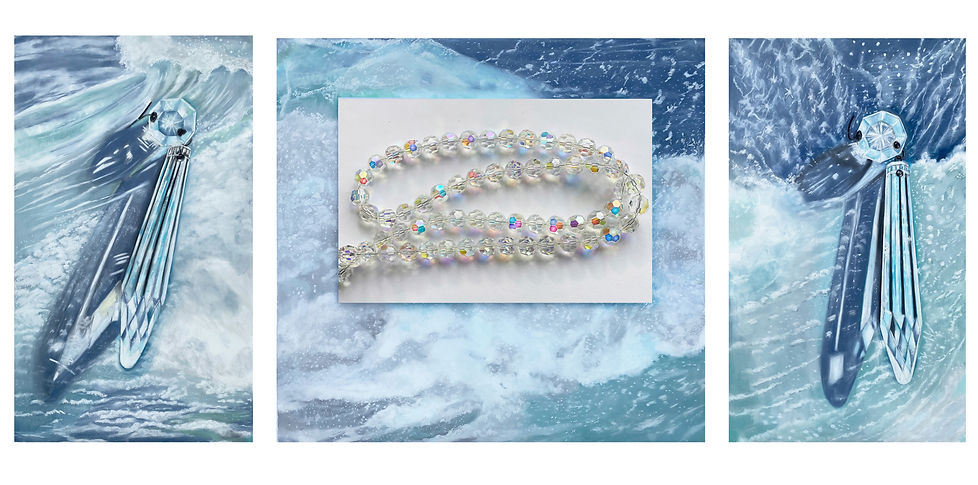
In terms of assemblage, Nancy Staub Laughlin works in two formats. The first format consists of photography mounted on paper with the rest of the composition filled in with a pastel drawing. And the other format consists of photographic assemblages where she creates a montage of two or more photographs with related imagery. In these original photographs from both formats of assemblage, we will often find performative still lifes, seascapes, and wintery landscapes. The still lifes and objects contained within the assemblages usually consist of jewels, pearls, flower petals, diamonds, crystals, beads, and glass. Typically, the objects are reflective and express a motif based in crystallization and refractured light. Like immaculate and luminous enchanted glass castles from another realm, these still life structures are carefully integrated into seascapes and wintery cropped landscapes usually containing a magnolia, wisteria, or similar types of trees. Some of Nancy’s most interesting pastel assemblages contain dark starry and cold nightscapes with sometimes a field of ice in the foreground, such as a frozen lake. These particular types of nightscapes handle well against the sparkle of jewels and the mystical starry passionate twilight.

Photo 28 (pictured above) depicts gemstones and crystals like a chain against a sparkling coastline. The concept being the sparkle in the body of water matches the glistening of the previous stones. With a combinative approach, the wholistic composition reveals a narrative based on expressing how luminosity and light can be expressed in reflection and shimmers, revealing a regal and enchanted environment.

The photographic assemblages have a puristic conceptual approach to them while the pastel assemblages seem more expressive. In the photographic assemblages, we will find strings of precious gems, crystals, and glass acting as magical prisms and gateways into landscapes. As if the artist is communicating these jewels are enchanted and provide ethereal insights into our mysterious surroundings. These playful compositions with their carefully constructed and performative still lifes reflect a sense of regality and prestige. The consistent sparkling elements in her work and manipulation of light reflects a thoroughly magical and enchanted quality to contemporary image-making. In both formats of assemblages, we will find portals into another dimension induced by very real materials carefully chosen and assembled into a performance of luminosity, a light show through the representation and reflection of light rather than a direct reference to the subject.

With magical qualities and constructed configurations expressing seemingly sacred surfaces through high quality imagery and subjects, Nancy Staub Laughlin creates art which has the viewer measure the value of light as well as the tools and garments which enhance our lives. These performative still lifes integrated with landscapes create clever inter-disciplinary approaches to the concept of cherishing. Through precious stones, reflective materials, wintery snowy-sparkling landscapes, gleaming bodies of water, and starry skies, the artist investigates how visual art defines cherishing mindfulness as well as expressing the concept of value. The worth of light, the regality of reflection, the ludic experiences of dreamy landscapes, and how combining experiences leads to a grander journey, these are the themes contained with the works of Nancy Staub Laughlin.

The assemblages incorporate mounted photography on paper with pastel drawings and often depict the subjects of precious gems and diamonds, foliage, and landscapes. Nancy also creates ‘pure’ collages of her own assembled photography. With a soft palette, Nancy explores crystalized forms in the formation of snow flakes, mist, pearls, and diamonds. Sparkling and gleaming, the assemblage strives toward unifying contradictory surfaces, one of captured realism through photography and the other of interpretative naturalism through pastel drawing.

Perfection of Rain (pictured above) depicts diamonds and gems glistening against a flurry of rain. The prismatic colors reflect light and reflect off of dripping water. With an array of pastel and realistic neon colors, the glass-like illumination and structures are arranged in a manner similar to a monument, with a centralized and pillar focus. Through monumentality in presentation and shimmering light, Nancy persuades the viewer to value the beauty of luxury.
Such integrative methods create holistic new interpretations of familiar subject matter. By arranging florals, fauna, and flowers against diamonds, gems, pearls, snow, and mist, she creates fascinating illusory consumption based on rearranging aesthetically pleasing topics into her very own compositions. The most interesting artists are the ones who can take a subject and transform the meaning, purpose, and visual consumption of the finished surface through integrative techniques such as assemblage, combining different mediums, or constructing handmade props to present a theatrical presentation. Nancy Staub Laughlin achieves all three. Her assemblages leave a presentation of lasting impression through subjects and application of delicate refinement, both literally and symbolically.

Through opulence and prestige, the assemblage works of Nancy Staub Laughlin portray a world crystalized by luxury and refinement. She places value on fine objects and reflects on nature to send a message on preservation and presentation. Much like the subject matter in her works, the assemblages are meant to be cherished and treasured for their glorification of refined beauty and glorious aesthetics. With integrative methods, Nancy redefines the role of visual consumption through perceptive depiction of rare subject matter of high value as the photography becomes leveled on a separate form of perspective against the pastel drawings. Bold and nuanced, Nancy can be described as an artist deeply engaged with her mediums and creating a presentation fit for royalty.

Interview with Nancy Staub Laughlin by Point Pleasant Publishing conducted on July 1st, 2018
Point Pleasant Publishing: As an artist who has had a solo exhibit in Chelsea and exhibited in museums as well as being critically acclaimed, what has led you up to this point?
Nancy Staub Laughlin: Number one, I would say confidence in my work is a huge factor in my success. Secondly, persistence and having a strong business sense has been essential. I am efficient and organized and can be the squeaky wheel. The trick is to know the fine line of over stepping the boundaries that could immediately put you in the no pile. Number three, it is so important to have your work constantly evolve, without losing your signature style. The ultimate compliment was having the late Sam Hunter, art historian/critic say to me, “I’ve never seen anything like this!” I will say, I have worked incredibly hard to be where I am now, but I am always planning for the next venue. I have a one person exhibit March 2017 at the Nancy Dryfoos Gallery, Kean University in New Jersey. I have been working on clinching the next exhibit, hopefully for 2019. Stay tuned….
Point Pleasant Publishing: The art critic, Sam Hunter, of Princeton University, wrote about your works being "[a] magical, fragmented still life and landscape reward us richly with the briefly perceived objects of a demanding vision, gloriously, dynamically reflected through the finely distorting fluidities of a fantastic water world". Could you explain to the reader about this essay and this "fantastic water world”?
Nancy Staub Laughlin: When I had the honor of Sam Hunter review my work, at the time, I was doing a series of pastels that involved submerging objects in the water. Water was a very common theme in all the drawings, with hence “this fantastic water world”. However, his other descriptions of my work from this quote, even though they were describing a previous series, still pertain to my current work. I still have “a demanding vision” that rewards the viewer “gloriously and dynamically”. I have stayed true to my unique self.

Point Pleasant Publishing: Curator, Ingrid Fox, wrote of your work as "Objects are added or subtracted and the end result creates an effervescence, sparkle and glow, which makes the inanimate come alive and brings all elements together as one." and Kate Somers, a curator at Princeton University described your work as individualized and described you as an "alchemist". What makes your work come alive in this alchemical process?
Nancy Staub Laughlin: I see the world in a different way than most people. I have an intuition to find glow and sparkle 24/7. In my drawings, I use my fascination of “sparkle and glow” and combine nature vs. glitter to put it simply. The kinetic aspect of each drawing brings the viewers eye around the drawing like “connect the dots”. The key is to capture and execute the landscape and the baubles artistically so the viewer can enter my beautiful world I have created.
Mastering pastels as a medium is crucial in the outcome of a successful drawing. There are many layers of pastel to create the depths and glows. The tricky part is not over working the pastel when blending or else the colors become muted and muddy. I work with many brands of pastel: hard to soft in order to blend properly. The added photograph in my assemblage; pastel/photograph series, accentuates and compliments the sparkle found in nature.
Point Pleasant Publishing: There seems to be a very contemporary mysticism contained within the art. Like as if there is a story to tell. Is there?
Nancy Staub Laughlin: There really isn’t a story, per say. My work captures the viewer and takes one on a scenic tour of my perceptive world. You are seeing through my eyes. I will find beauty and glow in just about anything! No matter where I am, I am drawn to sparkle.
Point Pleasant Publishing: Why do you use neon, pastel, and neutral (black and white) colors together?
Nancy Staub Laughlin: This is a tough question without a drawing to use as a reference, but I will say that the combination of these three types of color is what gives the drawing contrast, depth and interest. They also represent the seasons of color. The blacks ,grays and whites creates the winter palette. Black is also strongly used in the shadows to create the three dimensional effect of depth. The pastel hues depict the early spring, summer season and the neons are the fall. The colors I use, are the colors I see.
Point Pleasant Publishing: You have such a unique voice contained within the works, what advice would you give to people who aspire to become artists to reach such a destination?

Nancy Staub Laughlin: For those who aspire to be an artist, you were born with a creative voice. One can perfect amd learn new mediums; learn new processes, but the bottom line is, you must have innate talent. Stay true to who you are; don't follow the trend; and keep at it. Do not give up.
I will say that being an artist is not for the meek. Being an artist is basically applying for a new job every one has to prove over and over again who you are. That is assuming one can even get to the right person to tell your story. I have to say, this is a question I am asked quite a bit. I am honored that I am recognized as unique…this is the ultimate compliment!
Point Pleasant Publishing: What are your thoughts on the mediums of pastel and photography and the synergy you use between them?
Nancy Staub Laughlin: I LOVE pastels. I have learned how to control them after many years of working with them. I use my photography to capture moments that my keen eye will see; a glimmer of reflection; lights in the night, or an amazing landscape with the light glowing perfectly. I use these moments or photographs in my layered “stills” to create the appropriate balance of translucency, layering and glitter. In my newest series, I have created a new concept of the “still life” working with pastels on paper and photography. After photographing my “stills”, the photograph is used as a reference to complete the final drawing. These “assemblages”, actually incorporate the photograph into the pastel. These dynamic, layered assemblages allow the viewer to enter my world of color, light, dimension and beauty from a different perspective. They are the culmination of many carefully executed steps that define my distinctive creative process. I envelope the viewer, play with the balance of nature vs. glitter and unveil my glowing and unique world.