
Minyu Zhu: Philosophical Musings with Foreword by the Editor
Updated: Aug 15

Foreword:
Written by Michael Hanna, Editor of Point Pleasant Publishing.
This is not an interview with textile artist Minyu Zhu, but rather, documented conversations and philosophical musings about her practice. As a result, these writings are far more natural and fluid in comparison to a standard interview, and the contents as well as structure are more similar to an autobiographical essay. What strikes me the most about Minyu Zhu is how complex she is, both as an artist and person. Minyu and her work have immense layers of meaning towards many subjects, such as the unconfined sensibilities of women, sociological context based in observation of environments, contradicting traditional aspects of art (especially in regard to fiber materials), redefining the avant-garde, emotional and sensory experiences, and how we deal with resistance.

Minyu Zhu’s work is unique in being both research-based and fluxus at the same time. The research comes from intense observation from herself amidst her surrounding environments, at home, work, and even the urban streets of London. After graduating from the Royal College of Art, her practice has grown to be more casual and personal as opposed to the academic structure and discipline instilled by the college. The fluxus nature of Minyu’s work comes from reacting to her surroundings through dilapidated forms and structures, as if the formations of her work were impacted by the erosive qualities impacting the textiles as a state of fragility-in-strength. In other words, she is reverse-engineering the conceptual notion of fragility and post-structurally redefining the status of fragile states of being as virtuous stability. Think of glass for example. Glass can be made to be as fragile as paper or indestructible as a diamond, yet situates upon being beautiful, luminous, and complex, much like how a woman is. This status-in-being of fragility is reflective of the fluid female sensibilities conveyed in the textile works of Minyu Zhu.

To Minyu, female sensibilities are not a fixed concept or series of attributes. In her textiles, she conceptually conveys female sensibilities as bodily autonomy and awareness, intimate reflections, sensitivity, nurturing, and mindfulness towards experiencing space through the body. In a sense, Minyu Zhu’s textile works are like a series of dimensions in which the state of womanhood becomes transformed and portrayed in a fluid plane of consciousness, rather than a fixed sense of status or pre-conceived notions. In Minyu Zhu’s world, the female form, mind, body, and essence is far more complex and dynamic than what has traditionally been expressed throughout the formal documentation of art historical canon.

What makes the textile work of Minyu Zhu so avant-garde is the overt-rejection of defined observational forms, or even, conceptually conveying structural elements as if they were in a state of naturalized distress. These impressioned instances which shape the textile forms in her work are often based on reality, such as observations of domestic items, or revealing the psychological impulses when confined or expanded within an open space. For example, in works such as The Grid, the work may initially appear like a work of abstraction, but in actuality, is a way Minyu Zhu is conceptualizing the notion of a matrix, complex multi-dimensionality, or fluid structural elements. This ‘matrix’ or mulit-dimensional system captured in the form of a textile fragment becomes integrated with pools of water. The reflective aquatic droplets running through the bottom of the textile or in juxtaposition to the art reveals a prismatic texture on the surface of the fiber materials. Like a fine diamond, the intricately-weaved textile reveals an integration of fine materials and threads, interweaved.

Such complexity in Minyu Zhu’s works reveals a robust tension. Her works are like the refined composure of Mozart yet with the impactful and dramatic theatre of Beethoven. Such refinement reflects both the impact of both time and space. Her dilapidated structures of textile fragments, whether directly or metaphorically correlating with objects or ideas, seem to be a reflection of surface and texture impacted by the power of erosion. Much like time as an entity, erosion is a powerful force which can whither down even the most resilient substance. Through wind, water, particles, and time, erosion takes any element and reduces their configuration down to a withered, aged state. In the works of Minyu Zhu, her delicate textiles appear like parched surfaces which have been winded down to a status of petrification. In fact, some of her textiles even sort of have the appearance of petrified wood, at least in texture. Minyu Zhu’s capturing of erosion is conveying primordial elements within nature which makes up water, wind, and particles. This atmospheric tension much portrays her practice as one which defines time through elemental impact, process, and a oneness with nature.

In this discussion with Minyu Zhu, the reader will have a chance to note the complex mind of the artist; How she finds complexity in the mundane and discovers elements of life within the inanimate substances around us. She is a person of many layers who is acutely aware of her surroundings at all times. Minyu studies all the environments around her with great intensity, which are reflected in her textiles. From the urban streets of London, to individuals in both casual and formal settings, to the elements of nature, she studies the interconnective variables, behaviors, and patterns within us all. Much like life, Minyu Zhu is attracted to the independence and vulnerability of textile materials. The fragile fibers are delicate yet resilient, malleable and versatile which can be bent to the vivid distortions and machinations contained with the mind of Minyu Zhu. She treats the textile material much like an element which is interconnected with both human history and the human body. As she notes in the conversation we had, Minyu is deeply fascinated in how textiles conform to our body when worn and we are vulnerable with textile materials on our backs, making the substance an essential element. She finds such attributes to define the material as honourable and deeply fascinating.

What essentially defines the artistic practice of Minyu Zhu is a drive to define the avant-garde outside of art historical canon without completely denying history. She turns the fiber material into what would be considered the mundane aspects of life towards intricately constructed interweaved textile structures which can also interact with elements of nature, such as bodies of water. These ‘essential elements’ within her work define a new age presence which is at one with nature. A deep passion for the study of texture and surface creates contemporary ‘artifacts’ which seem to redefine sensibilities and interpretative reactions. In essence, Minyu Zhu’s textile works can be described as impressions of unique and distinctive sensibilities with malleable impressions, such as breathing in the air of fog from a mist-filled garden during the morning hours or observing droplets of soft rain fall onto the surface of a small pond.
So without further delay, I would like to introduce the extensive conversations I had with the artist, so here is Minyu Zhu in her own words The text from our conversations were edited by me for grammar and formatting purposes:

Philosophical Musings:
Written by Minyu Zhu, Textile Artist.
When I think about “female sensibilities” in relation to my work, I don’t necessarily see femininity as a fixed identity or a particular set of characteristics. For me, female sensibilities are more connected to an awareness of the body, intimacy, vulnerability, care, and the ways we experience space through the body. I am particularly interested in the tension between softness and strength, fragility and resistance, attraction and restriction. These are things I have come to understand through my own experience of living in a female body, as well as through the emotional and social implications which surround these experiences.

Textile feels particularly natural for exploring these ideas because of having such close associations with the body, touch, domesticity, labour and care. At the same time, I am interested in challenging those associations. I often combine textile with metal or other harder materials, stretching, pulling, knotting, piercing, or placing under physical tension. A material can appear soft while behaving almost aggressively, or look fragile while actually carrying a great deal of tension. Such contradiction is very important to me.

Since leaving academia, especially after my experience at the Royal College of Art, my life has become much less structured. I no longer have the framework of semesters, studio critiques and academic deadlines, so I have had to create my own rhythm. My time is now divided between making art, preparing exhibitions and applications, working, and dealing with all the practical things which come with living as an artist. Sometimes life can feel quite fragmented, but I think this has also made me much more attentive to everyday experiences. I spend a lot of time observing ordinary aspects: how people move through public spaces, how objects occupy a room, how clothing sits on the body, how materials change through use, and how very small physical interactions can create feelings of tension, intimacy or discomfort. I am also interested in textiles beyond the studio, particularly clothing, sewing, embroidery, domestic fabrics, and the different ways people live with and handle materials.

Living in London has become a big part of this; Commuting, working, walking through different neighbourhoods, visiting exhibitions, shopping for materials, cooking, travelling, and simply observing people all become part of the way I think. I don’t necessarily translate these experiences directly into artworks, but they accumulate in my mind and eventually influence the materials, forms and relationships appearing in my work. I think this is one of the biggest changes since leaving academia. My artistic practice and my everyday life have gradually become much less separate. I have become interested in the small physical and emotional experiences happening around us every day, particularly those we usually overlook.
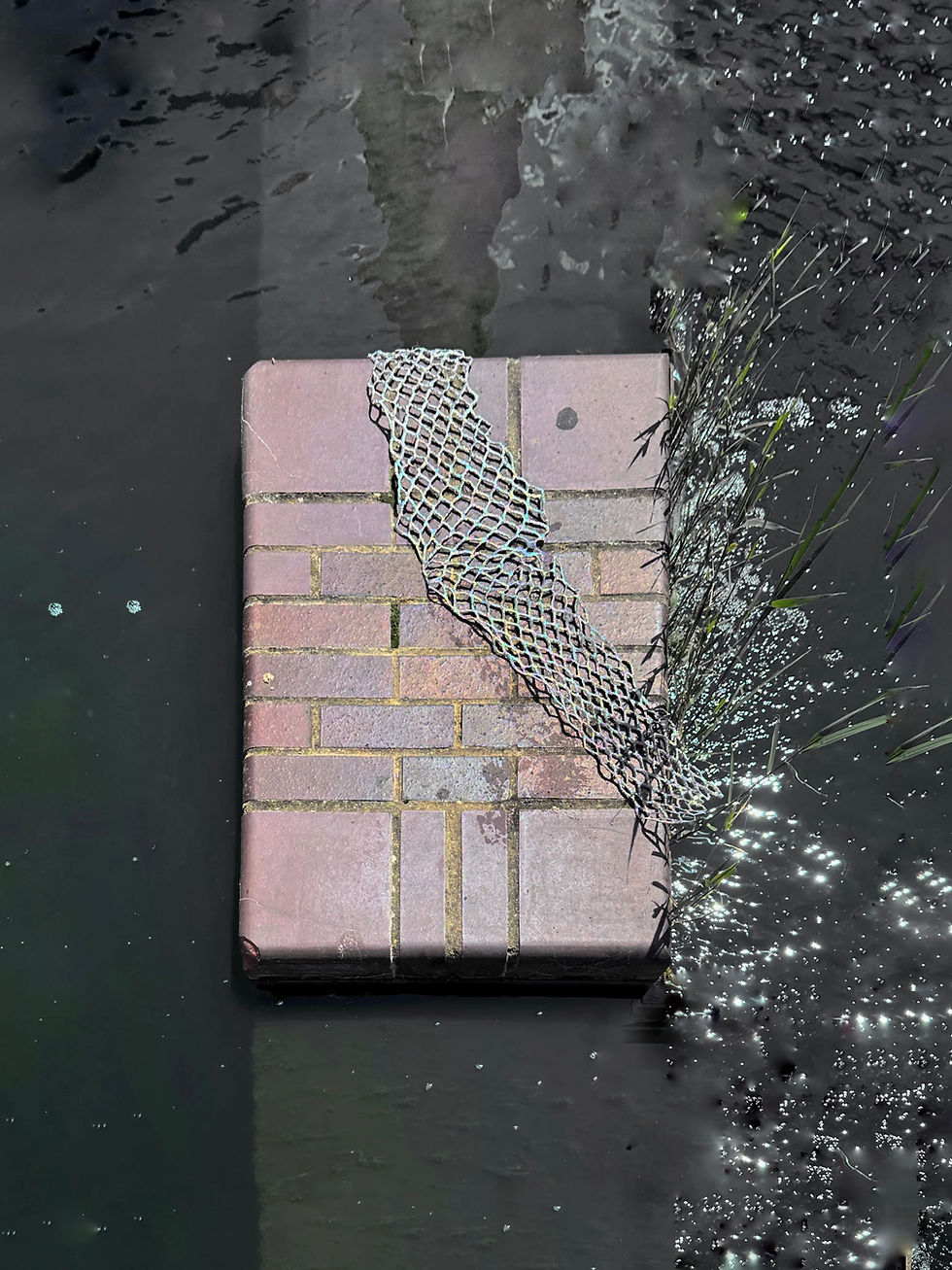
At the centre of my practice is probably this idea of relationships: between the body and material, softness and resistance, intimacy and distance, and the individual and the surrounding environment. These relationships also shape the way I look at the world outside the studio, so I feel my interests, daily experiences and artistic practice are becoming increasingly interconnected. I think my understanding of womanhood has become increasingly connected to the relationship between the body and the outside world. I don’t experience being a woman as one particular identity I have to constantly define. Rather, an element I experience physically, psychologically and socially, and these experiences can change depending on where I am and what situation I am in.

One of the actions which has made me more conscious of my womanhood is simply moving through cities alone. London can feel incredibly liberating because there is a strong sense of individual independence. At the same time, being a woman in an urban environment means I am constantly aware of my surroundings. I notice who is around me, how close someone is, how I position my body, which streets I take, the time of day, and how I respond to unfamiliar situations. These observations become almost subconscious forms of spatial awareness. I don’t necessarily think of these experiences as barriers in a purely negative sense. They have also made me more perceptive. Being aware of my surroundings has taught me to read space through the body, to notice subtle changes in atmosphere, distance and behaviour. I think this connects quite directly to my work. The body is never completely separate from the environment. Our figure always negotiate with objects, architecture, other bodies, social expectations and physical boundaries.

There is also something interesting about the contradiction between independence and vulnerability. Living alone, working, travelling around the city and building a life as an artist has given me a strong sense of independence, but such independence does not eliminate vulnerability. I think both can exist at the same time. Perhaps this is another reason why I am drawn to materials which can hold contradictory qualities: soft and hard, delicate and resistant, intimate and imposing. As for the future of visual art, I think the boundaries between different forms of art will continue to become increasingly fluid. I am interested in a future where artists don’t necessarily have to define themselves according to one medium. Painting can become installation, sculpture can incorporate sound, textiles can become spatial or performative, and moving image can exist alongside physical objects. I think audiences are also becoming more interested in experiences and environments rather than simply individual objects.

Besides textiles, I am particularly interested in installation, sculpture, performance and moving image. Performance interests me because of the relationship with the body and time. Installation interests me for allowing the work to exist within an environment rather than simply being viewed from a fixed distance. I am also interested in moving image because for introducing duration, repetition and movement, which are difficult to communicate through a static object. However, textiles remain central to me because of the very particular relationship they have with the body. Textile is something we wear, touch, sleep on, carry, wash, repair and live with. An extremely intimate substance and ordinary, yet also has a very long and complicated history within art, craft, gender and labour.

This is also why I find the distinction between ‘high art’ and craft increasingly interesting. Historically, textiles have often been associated with domestic labour and women’s work, and therefore positioned differently from painting or sculpture within the traditional hierarchy of visual art. I think history is still relevant, but also gives textile a very powerful contemporary potential. For me, the artistic value of textile does not come simply from the fact from simply being textile. Rather, coming from what the artist is able to do with the material conceptually and formally. A textile work can deal with the body, politics, memory, architecture, sexuality, labour, space, identity or materiality just as a painting or sculpture can. The medium does not determine the intellectual depth of the work.

In my own practice, I am interested in taking textile out of some of the more familiar contexts and making the material behave differently. When I combine fibre with metal, for example, I want the materials to create a physical and psychological tension. The textile can suggest softness, intimacy and the body, while the metal introduces weight, rigidity, resistance or even a sense of threat. The meaning emerges through the relationship between them.

So when I think about my work in relation to ‘high art’, I would probably say I am less interested in proving textile belongs within such a category and more interested in questioning why such categories exist in the first place. I want the work to be able to stand within context as an intellectual, physical and emotional experience, regardless of the material hierarchy historically assigned to my portfolio. I think this also relates to what you said about my work giving complexity and nuance to mundane aspects of ordinary life. Textile is part of ordinary life. Perhaps exactly what makes the material so interesting to me. Something can be familiar, domestic and seemingly insignificant, while carrying a huge amount of history, memory, labour and emotional meaning.

When I make work, I am often very close to the textile. I know the physical process, the materials, the decisions and the personal experiences which lead to such a conclusion, so sometimes I don’t see the work in the same way another person might. Reading your critical responses has made me aware of layers within my work I had felt intuitively but had never articulated clearly. For example, your writing has encouraged me to think more consciously about the sociological and psychological dimensions of my textiles. I originally approached many of these things through physical sensations and material relationships. After reading your interpretations, I began to understand there are also questions about the body, labour, gender, social behaviour, vulnerability and power embedded within those material decisions.

I think this has affected how I talk about my work to other people as well. I have become more comfortable allowing the work to have multiple interpretations rather than feeling I need to explain exactly how I define my practice. Your essays have shown me sometimes another person’s interpretation can reveal something which is already present in the work, even if I didn’t consciously put the description there. In terms of my career, I think the critical writing has been valuable by creating a record of my practice beyond exhibitions themselves. An exhibition eventually ends, and an image of a work can only communicate so much. Critical writing gives the work another form of existence and places the work within a wider intellectual conversation. I also think having someone engage seriously with my work in writing gives me more confidence the ideas behind the art can stand beyond the immediate visual experience.

Your writing has therefore affected both how I see my work and how I present my portfolio to others. I think the text has helped me understand my practice is becoming larger than the individual objects I make. As for the avant-garde, I think the contemporary avant-garde is increasingly difficult to define through a particular medium or visual style. Historically, we often understand avant-garde movements through their relationship to particular periods and artistic groups. Today, the situation feels much more fragmented. Artists are working across disciplines, cultures, technologies and forms of knowledge, so the most interesting experimental practices may not necessarily look like what we traditionally recognize as avant-garde.

I think today’s avant-garde can exist outside the traditional art historical canon precisely because artists have access to such an enormous amount of information and can move between different histories and disciplines very freely. An artist might draw simultaneously from textile traditions, digital culture, anthropology, architecture, popular culture, biology or personal experience. These combinations can create forms which don’t fit neatly into existing categories. For textiles, I think this is particularly exciting. Textile has historically occupied an unusual position between fine art, craft, domestic labour and everyday life. Because of such history, contemporary textile artists have an opportunity to question those boundaries rather than simply trying to move textile into the established category of visual art.

I also think the future of contemporary art will become increasingly concerned with relationships rather than categories. The distinction between sculpture, installation, performance, film, textile and digital media will continue to become less important. What matters more to me is what kind of experience or thought a work can produce.

When people encounter my work, I don’t necessarily want them to leave with one specific message. I would rather create a moment where they become more conscious of their own bodies, their surroundings, or the relationships between elements. I am interested in slowing down perception.A textile can be very familiar. We encounter fabric every day, often without consciously thinking about the material. When I manipulate, stretch, combine the textile with metal, or place within an unfamiliar spatial relationship, I hope the viewer begins to look at something ordinary differently. Perhaps this is the kind of change I hope my work can create. I don’t think art necessarily needs to tell people how to live or what to believe. Sometimes simply making someone pause, question a familiar object, notice their own physical response, or become aware of a relationship they had previously overlooked can be meaningful enough. In such a sense, I think my work is ultimately about attention.
