
The Young Avant-Garde: featuring Kennedy Malsch & Meg Lewis

graphic-based installation by Meg Lewis
Kennedy Malsch and Meg Lewis are two very different artists, but both represent the contemporary young avant-garde. With the work of Kennedy, she deals with fluxus photography which is usually analogue in practice with a unique gift to perfectly integrate her models seamlessly into nature, as if they were sirens lurking from the shadows of the forest. Meg Lewis, on the other hand, is an experimental graphic-based installation artist who creates her own sense of anti-narrative mythology borne from research on theology, history, and conveying a rebellious attitude towards the mental prison of digitization. What these two young artists have in common is a sense of anti-surveillance rejection of the prying eyes of the information age. Kennedy Malsch’s figures seem to emerge from the abyss…and stare back, while Meg Lewis’ characters and machinations are disfigured or mythological entities seeking salvation and enlightenment.

fluxus analogue photography by Kennedy Malsch
In the current contemporary climate, those within the avant-garde realm must counter against an avalanche of disinformation and propaganda in the arts. Because the conventional art world has never been more institutionalized than today, aspiring young artists from grade school all the way to MFA programs are often encouraged to ‘follow the formula’. The ‘formula’ is over-consistency, marketability, being inoffensive yet just slightly edgy enough to warrant the attention of poorly-informed collectors.

graphic-based installation by Meg Lewis
Those of us working outside the mainstream and the commercialized art world must give a voice and platform to the young avant-garde, because they are the key to gaining influence and spreading enlightenment, especially to the next generation. We mid-career artists in our 40s, 50s, and 60s do not nearly have the same impact of influence as the young avant-garde, because historically, audiences and gallerists respond better to youth in the arts. Why? Perhaps the young are more charming despite not being as experienced, or maybe because their brains are more intact due their biological youth and can see fresh perspectives more clearly.

fluxus analogue photography by Kennedy Malsch
With Kennedy Malsch and Meg Lewis, these artists help push the boundaries of contemporary art by delving outside the confines of familiarity. Their integrative and interdisciplinary approach of either combining fluxus sensibilities, mythology or a reconstruction of so, and a rejection of imposed narratives. You could argue the work of these artists are anti-institutional, and isn’t this exactly what makes someone avant-garde? Rejecting imposed cultural and structural formalities? The cabal network of the commercialized art world cannot compete with such visionaries, because artists such as Kennedy Malsch and Meg Lewis create for a higher purpose. Not to entertain or appease anyone, but rather a search for attaining enlightenment. We will find enlightenment is not found in filtered or censored information, but rather by intuitional interpretations of environments either imposed upon us or openly explored by our free will.
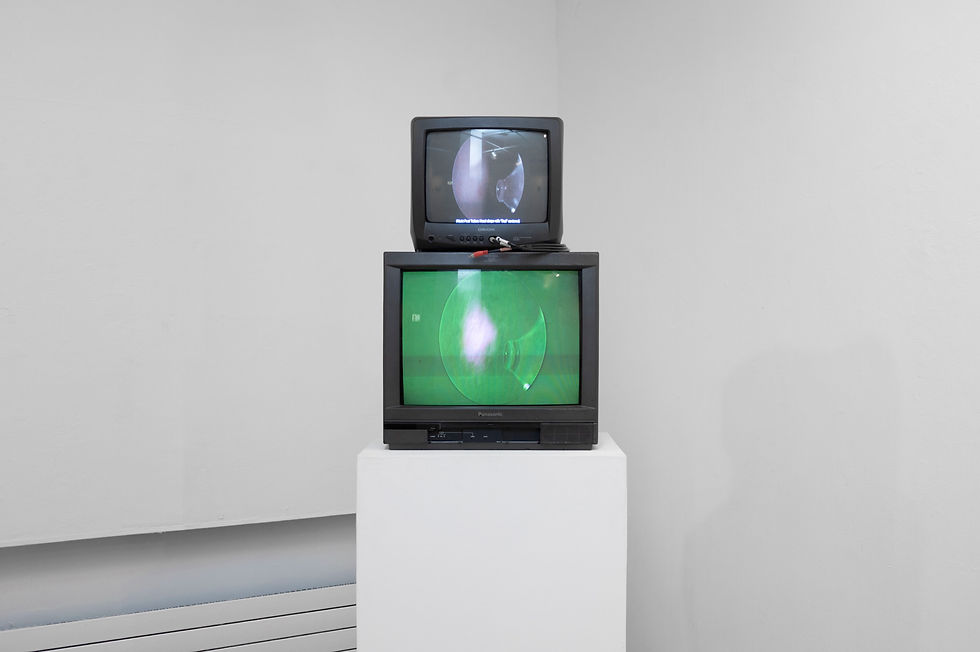
moving-image installation by Meg Lewis
The sense of release and escape from confinement is evident in both the works of Kennedy Malsch and Meg Lewis. With Kennedy’s work, the subtle gracefulness of her compositions reveal characters which seem to both charm and haunt us, as if they have emerged as apparitions from another plane of consciousness. Meg Lewis reveals a mythologically-constructed world which seeks to deconstruct realms of digitization and ‘fly’ to other-worldly dimensions in pixelated metamorphosis.

fluxus analogue photography by Kennedy Malsch
Our collective understanding of the young avant-garde is usually associated with hipster painters in New York recently discovered by blue-chip galleries. This is not the avant-garde…this is the packaging of the avant-garde through the eyes of the commercialized art world. Likewise, we will find the true young avant-garde are often working behind the scenes in the shadows. They are not always totally emerging artists by classical definition standards, but they mostly reside outside the mainstream art world. The true young avant-garde are after a higher goal rather than commercialized-recognition or validation from the establishment or motivated by financial goals, rather, they seek to enlighten themselves and their audience for a search of poetic-fluxus depth and conceptual provocation.

graphic-based installation by Meg Lewis
In our collective search of knowledge, we have lost access to the truth and the information which matters. Being the young avant-garde is not about embodying the most knowledge or experience, but an understanding there is an experimental purpose which cannot be defined by institutional barriers or imposed narratives. Which is why the most experimental artists usually (but not always) reject narratives and always revolt against institutional formalities. In essence, the young avant-garde are rebels with a cause. Freedom fighters seeking to spread and attain enlightenment. The young avant-garde are poet-philosophers searching to advance the principles of post-structuralism, not essentially through abstraction, but in conceptual ruminations of direct reference and deconstruction of reality to turn the system upside down.

fluxus analogue photography by Kennedy Malsch
This is exactly why some artists are increasingly finding the established gatekeepers to be largely irrelevant, especially the older avant-garde and the young avant-garde. With the advancement of the information age, the art world has essentially split into two realms. What was once a monolithic art world has fractured into two opposing planes: the commercialized art world and the avant-garde art world. What separates these two art realms? The commercialized art world is only motivated by access, money, and power while the avant-garde art world is only concerned with attaining and spreading enlightenment. They have nothing in common. But make no mistake, the commercialized art world and established gatekeepers are more institutionalized than ever before, with middle-men (such as art historians) ensuring the public relation interests of corporations, non-profit organizations, and various NGO’s are carried out with great precision and execution.

graphic-based installation by Meg Lewis
Our understanding of the avant-garde collectively must be reset. Not only this. We also need to reevaluate as a society what we consider to be valuable art. Instead of design principles and technique, we need to focus on mystery, poetry, and conceptual provocation. The reason why provocation is so important in the arts is because without pushing barriers, no one can truly claim to be avant-garde or represent the overall advancement of the arts towards a sense of evolution, to an expansion of consciousness and a catalyst of enlightenment.

fluxus analogue photography by Kennedy Malsch
As we celebrate Kennedy Malsch and Meg Lewis, we should also value their contributions to present discourse, not only in a documented sense. Their interpretations of the contemporary digital era as a prism of confinement which needs to be released reveals how the young avant-garde are essentially searching for freedom amidst imposed tyranny of institutional barriers and imposed narratives, which frankly, have little to no relevancy to advancing overall international contemporary discourse. The contemporary experimental arts no longer reflect around solely presentation and aesthetics, but rather in interdisciplinary practices and cross-intellectual pursuits which examines the greater purpose of our individual and collective role amidst and against contemporary industrialization.

graphic-based installation by Meg Lewis
Addiction, nihilism, salvation, glory, mania, enlightenment, rejection, these are some of the various impulses which need to be explored by the young avant-garde, who can especially tap into these themes with sensibilities and perspectives of youth. Like in the performance work of Mädchen Vivi and Fina Ferrara, Kennedy Malsch and Meg Lewis are not essentially after technique or traditional narratives. They insist in applying a rebellious attitude towards a rejection of traditional constructs, which have come to no longer reflect values or a sense of being noble. Tradition has now turned to represent imposed tyranny against those who wish to advance discourse to a higher purpose outside the confines of popularity and propaganda towards the masses.

graphic-based installation by Meg Lewis