
Timothy Hall

Timothy Hall is a digital photographer with a background in corporate photography and videography. He describes his process as the following: “I began using long exposures and motion…as I wanted the camera to ‘make’ the picture, not simply ‘take’ the picture…Then I apply different blending algorithms, which are just mathematical formulas, not all different from the chemistry in analogue photography. Every piece I create uses the full frame of the camera, with no other manipulation besides the developing and layering”.

Using in-camera editing and some computer software, Timothy Hall digitally-alters his photography in a similar manner to how an analogue photographer manipulates their prints in the lab. By using long exposures and blending, he distorts his photographs to be no longer recognizable of the subject captured. As a result, his compositions are heavily distorted and pixelated, creating a very digitized aesthetic. His digital process can be described as ‘organic’ as he does not rely on software outside of the camera to engineer his imagery. In these images, we will find streaks of light which might remotely resemble street lights or even daylight, but ‘pulled’ with great force and ‘destroyed’ through repeated pixelization until they are rendered as luminous streaks across his composition. How Timothy Hall captures and distorts light remains a defining characteristic of his work because their configuration does not only rely on blending algorithms, but also long exposures as well, which is a deeply photographic process.
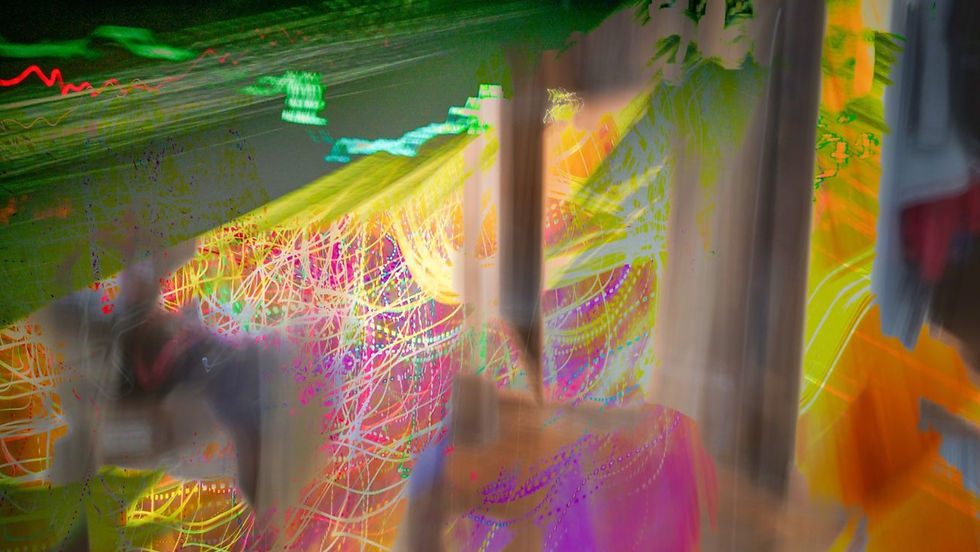
The process matters as much as the finished composition in Timothy Hall’s work. What makes his work fascinating would be although his work very much appears like 100% analogue digital art, they are instead in fact largely photographic since they heavily rely on in-camera editing, much like the erosive and corrosive process of an experimental analogue photographer in the lab mixing emulsions and chemistry. ‘Destroying’ his subjects beyond recognition essentially makes him an abstract artist, or rather abstracted artist, since he has pixelated his motif beyond comprehension and based on an original source material. As a result, we are left with streaks of color smearing the surface with immense luminosity of tones, rich in neon hues which give a cybernetic or even vaporwave or synthwave aesthetics.
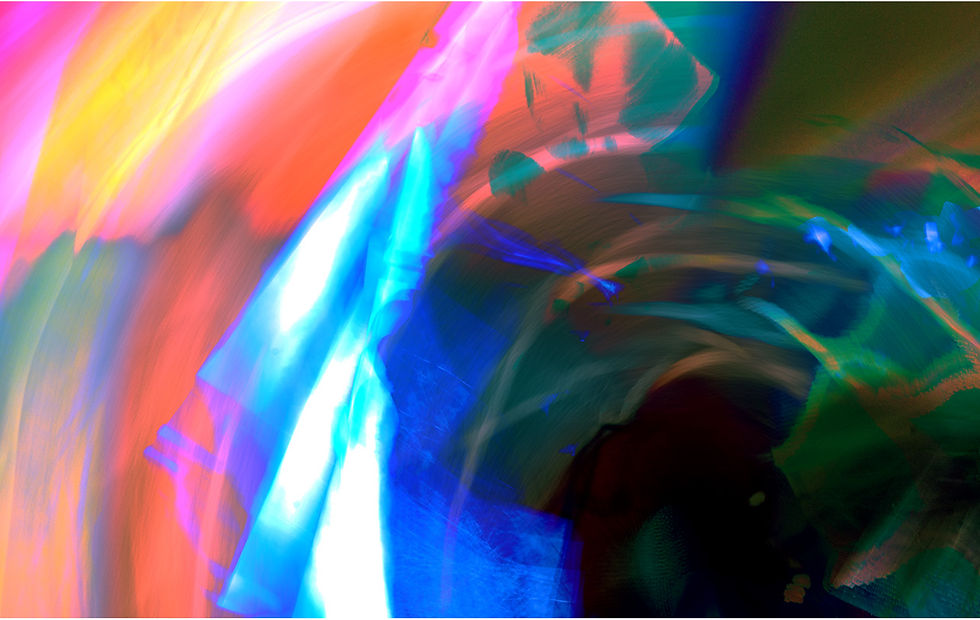
Black Sun (pictured above) becomes notable for conveying these futuristic color schemes combined with an element of distorting the subject into abstraction. Based on the title, the original photography could have been a beach scene or landscape in daylight, but pixelated into oblivion through the camera. The swirling contours and composition reveals a dynamic whirlwind which draws the viewer towards the center of the frame.

These in-camera-edited and computer-enchanced photographs of Timothy Hall explore research into how photography can be composed outside of the lab and the computer, yet altered. His work is not based on subject matter but rather to take forms which he finds interesting, capturing them with the camera, and then inventing machinations of a mad scientist within the lab of camera’s sensor frame as well as on computer software. Timothy Hall’s work is a fascinating case study in how process in alternate and integrative techniques can be used to advance not only photographic principles, but the very avant-garde direction of contemporary art and discourse. He can be described as an experimental artist who conducts himself based on creating lucid environments which are authentically created using dynamic and organic processes free of total automation.


